ASML’s High-NA EUV lithography tools have reached production readiness, the Dutch company’s chief technology officer confirmed this week, marking a concrete step toward the next generation of AI chip manufacturing.
ASML holds a global monopoly on commercial extreme ultraviolet lithography equipment — the machines without which advanced semiconductor fabrication cannot happen. Its new High-NA EUV tools represent a significant step beyond the current generation, which is approaching the physical limits of what it can deliver for AI chip production. Chipmakers building the semiconductors that power large language models and AI accelerators have been pressing against those limits. High-NA EUV is designed to extend them, enabling finer and denser circuit patterns to be printed in fewer process steps, which yields chips that are both more powerful and more efficient.
ASML’s chief technology officer Marco Pieters made the announcement ahead of a technical conference in San Jose, speaking exclusively to Reuters. His case for production readiness rests on three specific data points the company plans to release publicly. The High-NA tools have now processed 500,000 silicon wafers. They have achieved approximately 80% uptime, with a target of 90% by the end of the year. And they have demonstrated imaging precision capable of replacing multiple conventional patterning steps with a single High-NA pass. Pieters described the volume of customer testing accumulated as the key indicator. “I think that it’s at an important point to look at the amount of learning cycles that have happened,” he said.
The machines are extraordinarily expensive. Each unit costs approximately $400 million — roughly double the price of the previous EUV generation — making them among the most costly pieces of capital equipment in industrial history. TSMC and Intel are among the confirmed early adopters already working with the technology.
Pieters was deliberate in drawing a distinction between technical readiness and full manufacturing integration. The milestone announced this week means chipmakers can now begin the formal qualification process. It does not mean the tools will be producing chips at scale immediately. Full integration into high-volume production lines is expected to take another two to three years as manufacturers work through qualification and process development. “Chipmakers have all the knowledge to qualify these tools,” Pieters said, expressing confidence in the industry’s capacity to move forward even within that extended timeline.
The practical implications for AI hardware are significant but not immediate. Current EUV machines will continue driving chip production for the near term. High-NA EUV represents the infrastructure layer being laid now for the performance improvements that will follow. The semiconductor industry operates on long horizons — decisions made in equipment procurement today shape what chips are manufacturable half a decade from now.

What changed this week is that ASML has formally declared the starting conditions met. The technology has accumulated sufficient real-world testing, demonstrated sufficient operational reliability, and proven sufficient imaging capability to hand off to chipmakers for the next stage. The qualification work now begins in earnest, and with it, the gradual path toward AI chips built on processes that today’s tools cannot reach.
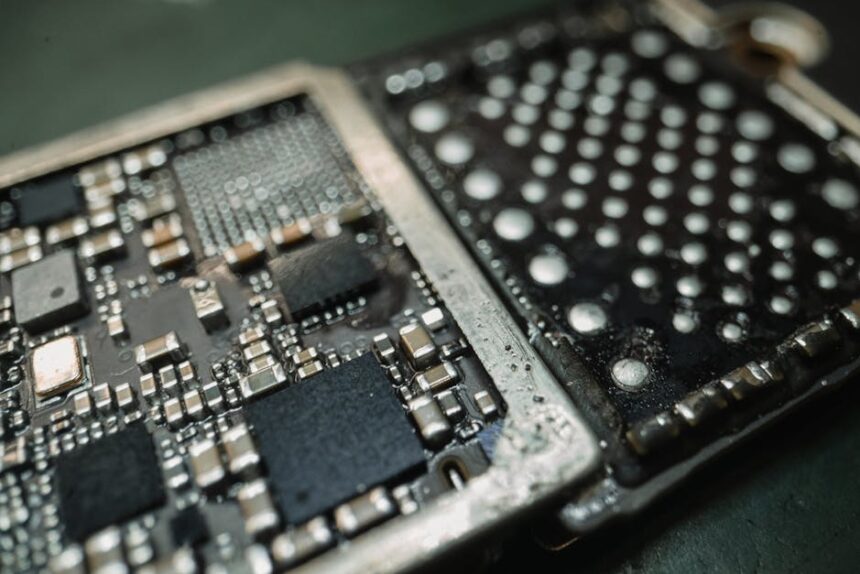
Photo by Tima Miroshnichenko on Pexels
Source: Original reporting