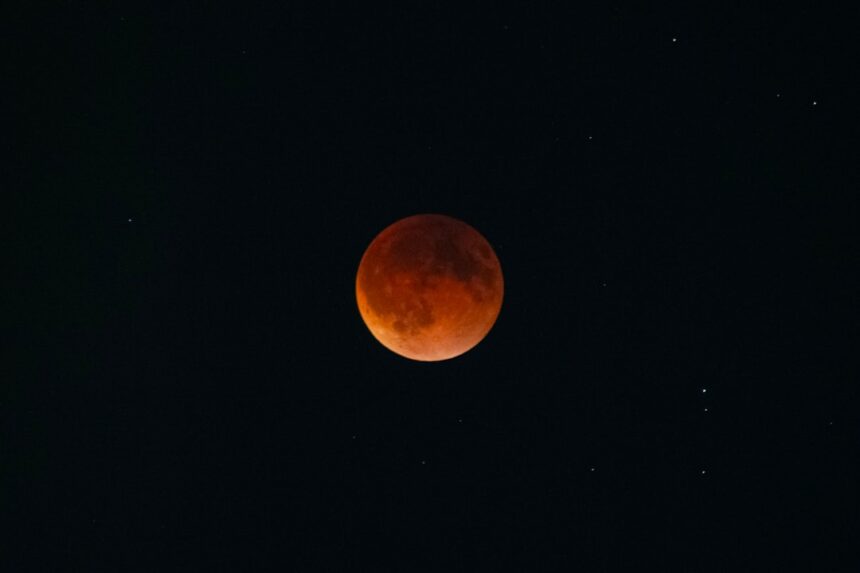
On the night of March 2 into the early hours of March 3, a total lunar eclipse will turn the moon a deep coppery red — a phenomenon commonly called a “blood moon.” Earth’s shadow will fall completely across the lunar disk, and light filtered through our atmosphere will give the moon its distinctive russet tone. More than 3.3 billion people across the Americas, Asia and Oceania are positioned to see some portion of the event.
For those whose skies are overcast, or who simply aren’t in the right location, three free YouTube livestreams will carry the eclipse in real time.
Time and Date begins its coverage at 4:30 a.m. EST, streaming live views from Los Angeles and Western Australia. Journalist Anne Buckle and astrophysicist Graham Jones will provide commentary throughout. The Virtual Telescope Project starts earlier, at 3:30 a.m. EST, drawing on a network of astrophotographers in Australia, the United States and Canada. Gianluca Masi, the project’s founder, will lead that broadcast. Griffith Observatory in Los Angeles begins streaming at 3:37 a.m. EST, offering continuous coverage from the penumbral phase — when Earth’s outer shadow first grazes the moon — through totality and the gradual retreat of the shadow afterward. The observatory’s position on the west coast makes it well-suited for end-to-end coverage.
The mechanics are straightforward. During a total lunar eclipse, the moon moves fully into Earth’s umbra, the darkest inner portion of its shadow. Sunlight doesn’t vanish entirely — it bends around Earth’s edges and reaches the moon, but only after passing through the atmosphere, which scatters shorter blue wavelengths and allows longer red ones to pass. The result is that reddish wash visible from the ground.
Totality, the phase during which the moon appears fully red, is typically the most visually striking portion. The exact shade can vary depending on atmospheric conditions on Earth at the time — volcanic dust or heavy cloud cover can deepen or mute the color.
For anyone hoping to photograph the event rather than just watch it, the technical challenge is real. The moon dims considerably during totality compared to its normal brightness, which means camera settings that work for a full moon will underexpose during the blood moon phase. Longer exposures and wider apertures become necessary, along with a stable tripod to avoid motion blur.
The eclipse will be visible without any special equipment — unlike a solar eclipse, a lunar eclipse requires no filters or protective eyewear. A clear sky and a reasonable view of the horizon are all that’s needed for direct observation.
For those unable to step outside at all, the three streams together cover multiple geographic vantage points and span the full duration of the event.
Photo by Alexander Gluschenko on Unsplash
This article is a curated summary based on third-party sources. Source: Read the original article