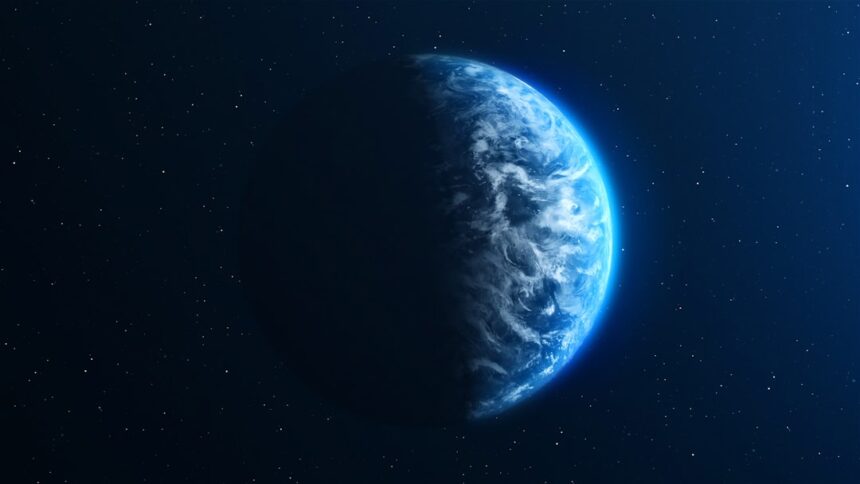
The solar system’s moons are far more than background decoration. They are geologically active, chemically complex, and in some cases, potentially habitable worlds that have become central to modern planetary science.
Jupiter and Saturn dominate the moon count by a wide margin, each hosting dozens of satellites. Some of these are tiny, irregular bodies likely captured by gravity long ago. Others are substantial worlds in their own right — Ganymede, for instance, is larger than Mercury. Europa harbors a liquid water ocean beneath its icy crust, and Titan, Saturn’s largest moon, has lakes of liquid methane and a thick nitrogen atmosphere. These are not footnotes to planetary exploration. They are the destinations.
NASA’s Europa Clipper is already on its way to study Jupiter’s icy moon in detail, with a focus on understanding whether conditions beneath the surface could support life. The Dragonfly mission, a rotorcraft lander, is heading to Titan to examine its chemistry and surface. Both missions reflect how fundamentally the scientific community’s attention has shifted outward — away from the inner planets and toward these remarkable satellites.
Uranus also carries a sizable collection of moons, many named after characters from Shakespeare and Alexander Pope. Miranda, one of the smallest, features a cliff called Verona Rupes that may be the tallest in the solar system. These worlds remain largely unexplored. No spacecraft has visited the Uranian system since Voyager 2 passed through in 1986, leaving enormous gaps in what scientists understand about them.
Mars sits at the other end of the scale. Its two moons, Phobos and Deimos, are small and irregular, and their origin remains genuinely uncertain. One leading theory holds that they are captured asteroids. Another suggests they formed from debris after an ancient impact. Neither explanation fits perfectly with current observations.
Earth’s own moon continues to yield surprises. Recent research has refined understanding of its formation, its internal structure, and the distribution of water ice in permanently shadowed craters near the poles. The Artemis program, despite scheduling challenges, is oriented in part around building a sustained human presence in the lunar vicinity — treating the moon less as a destination and more as a proving ground.

What makes moons collectively significant is the breadth of questions they raise. They are records of early solar system conditions, laboratories for geology and chemistry, and in some cases, the most promising places to look for signs of biology beyond Earth. The variety is striking. Io erupts continuously, making it the most volcanically active body in the solar system. Enceladus vents water vapor from its south pole. Triton orbits Neptune in the wrong direction, suggesting it was captured rather than formed in place.
No single narrative covers all of them. Each moon carries its own history, and scientists are still piecing those stories together.
Photo by Javier Miranda on Unsplash
This article is a curated summary based on third-party sources. Source: Read the original article