The standard model of cosmology, one of science’s most successful frameworks, is facing pressure from new observational data that suggests dark energy may not behave as physicists have long assumed.
A powerful telescope has mapped millions of distant galaxies to trace the universe’s expansion with unprecedented precision. What it appears to reveal is that dark energy, the mysterious force driving that expansion, behaves in ways that challenge the foundational assumptions baked into the current model, known as lambda-CDM.
A Century-Long Narrative Under Strain
The lambda-CDM model was assembled over roughly a century of observation and theory. It begins with Albert Einstein’s 1915 theory of general relativity, which describes gravity as massive objects warping space-time. Einstein originally included a “cosmological constant” to keep the universe static, then abandoned it after Edwin Hubble observed galaxies moving apart in 1929, confirming the universe was expanding.
The big bang theory followed, and wasn’t widely accepted until the 1960s, when astronomers detected the cosmic microwave background, primordial radiation whose properties matched theoretical predictions. Later, observations of invisible dark matter explained how galaxies held together. Then, in the late 1990s, Adam Riess and colleagues made the unexpected discovery that the universe’s expansion was accelerating. Einstein’s cosmological constant was effectively reinstated, rebranded as dark energy.
Lambda-CDM uses just six parameters to describe the entire history of the cosmos. Its predictive precision across decades of increasingly demanding observations has made it a benchmark achievement in physics.
What the New Data Is Showing
The Dark Energy Spectroscopy Instrument (DESI) has now produced a large-scale map of the universe, charting the positions and distances of millions of galaxies. The data traces the universe’s expansion history in finer detail than was previously possible, and the results appear inconsistent with dark energy behaving as a simple, fixed constant.

If the findings hold up, they point toward something more dynamic, a form of dark energy that changes over time. That would require a significant revision to the theoretical framework cosmologists have relied on for decades.
Riess, an astrophysicist at Johns Hopkins University who shared the 2011 Nobel Prize in Physics for the discovery of dark energy’s accelerating effect, captured the mood in the field directly. “We’re at an interesting moment,” he said, comparing the situation to a critical scene in a documentary: “I would say: ‘Don’t go to the bathroom now.'”
What Comes Next
Theorists are now seriously considering a rewrite of dark energy. The exact direction that rewrite takes remains open. Some researchers are exploring models where dark energy varies with time, others are questioning deeper assumptions about the uniformity of the universe at large scales.
The lambda-CDM model’s six-parameter elegance has been its greatest strength. Any replacement framework will need to match its predictive precision while also accounting for what the new data is showing. That is a high bar, and no obvious successor has yet emerged.
The results are not yet confirmed to a degree that mandates a formal revision, but the data is substantial enough that the cosmology community is treating it seriously. The universe’s expansion history, mapped in greater detail than ever before, is telling a story that the current script does not fully explain.
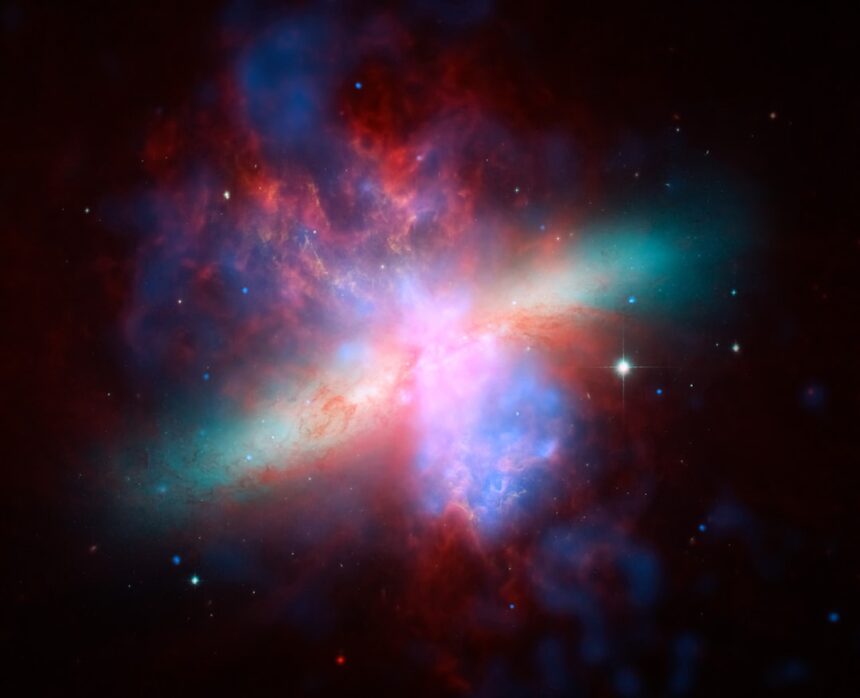
Photo by NASA Hubble Space Telescope on Unsplash
This article is a curated summary based on third-party sources. Source: Read the original article