Physical AI, the discipline of building machines that perceive, reason, and act in the real world, has moved from research curiosity to commercial priority with unusual speed. The shift is visible simultaneously across factory floors, chip architectures, and national showcase events, suggesting a structural change rather than a product cycle.
Nvidia CEO Jensen Huang framed the moment at CES in January as “the ChatGPT moment for robotics.” The comparison does useful work. It positions physical AI not as a distant frontier but as a technology crossing from specialized research into mainstream deployment, the same crossing that generative AI made in late 2022.
A Platform Race, Not a Robotics Race
The companies investing most aggressively in physical AI are not robotics specialists. They are infrastructure companies treating robotics as the next surface on which AI gets monetized.
Nvidia released new Cosmos and GR00T open models for robot learning and reasoning, alongside the Blackwell-powered Jetson T4000 module, which delivers 4x greater energy efficiency for robotics computing. Arm has established an entirely new Physical AI business unit focused on semiconductor design for robotics and intelligent vehicles. Siemens and Nvidia announced plans to build what they are calling an Industrial AI Operating System, targeting the world’s first fully AI-driven adaptive manufacturing site.
Google made perhaps the most structurally significant move, pulling its robotics software unit Intrinsic out of Alphabet’s “Other Bets” and directly into Google’s core business. The result is a vertically integrated stack: AI models from DeepMind, deployment software from Intrinsic, and cloud infrastructure from Google Cloud. Internally, the Android analogy circulates. Android didn’t win smartphones by building the best hardware. It won by becoming the layer everything else ran on.
Enterprise demand supports the ambition. A Deloitte survey of more than 3,200 global business leaders found that 58% are already using physical AI in some capacity, with that figure rising to 80% among those with plans over the next two years. The question has shifted from whether to adopt to how fast and on whose platform.

China’s Different Calculus
China’s physical AI story carries a different character. At this year’s Spring Festival Gala, humanoid robots from multiple Chinese startups performed kung fu routines, aerial flips, and choreographed dances before hundreds of millions of viewers. One year earlier, stumbling prototypes were drawing scepticism. The contrast was deliberate.
The numbers behind the spectacle are substantial. China accounted for over 80% of global humanoid robot installations in 2025 and over half of the world’s industrial robots. The country controls roughly 70% of the global lidar sensor market and leads production of harmonic reducers, the precision gears critical to robot movement. Hardware costs have fallen through the same economies of scale that propelled China’s electric vehicle sector.
Alibaba entered the foundation model layer with RynnBrain, an open-source AI model designed to help robots comprehend the physical world and identify objects, placing it alongside Nvidia’s Cosmos and Google DeepMind’s Gemini Robotics in direct competition. With over 140 domestic humanoid manufacturers and more than 330 humanoid models already unveiled, China’s embodied AI push is operating at commercial scale.
What Makes This Moment Different
Prior robotics waves stalled because the hardware, software, and economics rarely converged at the same time. This one features Western platform strategies and Eastern manufacturing scale advancing simultaneously, each with distinct competitive advantages. Boston Dynamics‘ Atlas robot has begun operating autonomously inside Hyundai‘s manufacturing facility in Georgia, a marker of how far deployment has progressed beyond controlled environments.
The ecosystem being built now is genuinely global, competitive on multiple fronts, and no longer waiting for a breakthrough. It is executing on one already in progress.
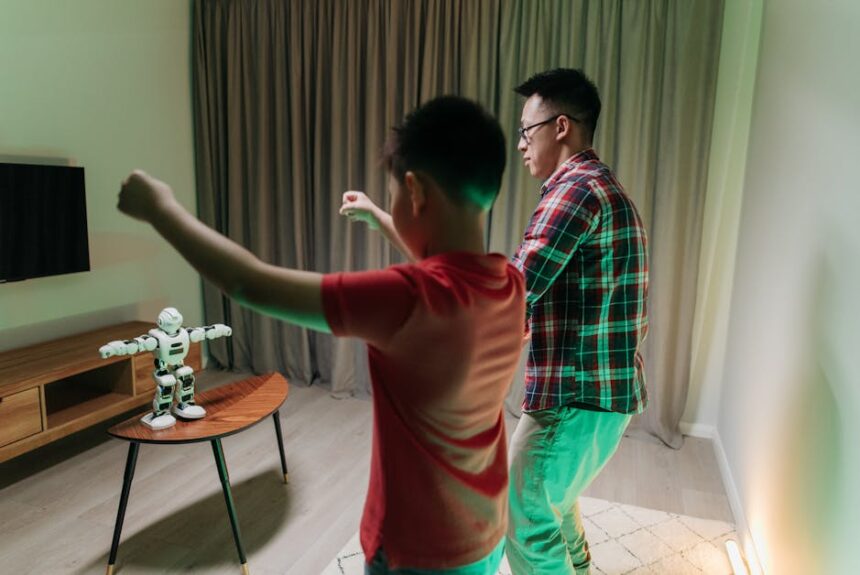
Photo by Pavel Danilyuk on Pexels
This article is a curated summary based on third-party sources. Source: Read the original article