A new exhibition at the Royal West of England Academy in Bristol brings together artists and astronomers around a shared act of translation, converting observation into meaning across disciplines. Cosmos: The Art of Observing Space runs until 19 April and positions the sustained gaze as a method common to both scientific inquiry and artistic practice.
Curator and artist Ione Parkin frames the show around this idea directly. “We recalibrate our perspectives nourished by the prolonged experience of the sustained gaze,” she writes in an accompanying essay, linking nights of stargazing with the painstaking study of scientific data.
Photography Frozen in Time
Artist Janette Kerr worked with communities in Iceland, Greenland, Shetland and Somerset to produce solargraphy images, a photographic technique that uses exposure times measured in months rather than seconds to capture the arc of the sun across the sky. The resulting images compress entire seasons into a single frame, treating time itself as a material.
The technique requires almost monastic patience. There is no instant result, no preview. The image only exists after months have passed.
Solar Technology Across Millennia
Alex Hartley takes a different angle, combining a physical solar panel with manipulated photographs of Neolithic standing stones. The work draws a direct line between ancient solar observation and contemporary energy harvesting, treating both as expressions of the same human impulse to engage with the sun. The continuity Hartley constructs is not sentimental; it reads as a factual statement about our relationship with solar power across thousands of years.
The Surface of the Sun, Painted
Parkin’s own contribution to the exhibition is a painting that swirls with reds and oranges, broken by cracks of bright white. The work evokes the restless, turbulent motion of super-heated plasma on the sun’s surface, a subject that satellite imagery has made familiar but which remains almost impossible to fully comprehend at human scale. Paint, in this case, closes a perceptual gap that photography alone cannot.
Imagining the Unknown
Michael Porter contributes a work titled Impossible Landscape, depicting environments that reach, as Parkin writes, “beyond the experientially knowable.” Porter textures his alien vistas with rocky and icy formations drawn from terrestrial geology, grounding the speculative in the recognizable. The strategy is deliberate: anchoring the unfamiliar in known physical structures makes the leap into the unknown feel navigable rather than abstract.
The exhibition does not argue that art and science answer the same questions. It suggests, more modestly, that they ask them in compatible ways. Observation is the shared starting point. What each discipline builds from there diverges, but the work on display at the RWA makes a case that the divergence is productive rather than absolute.
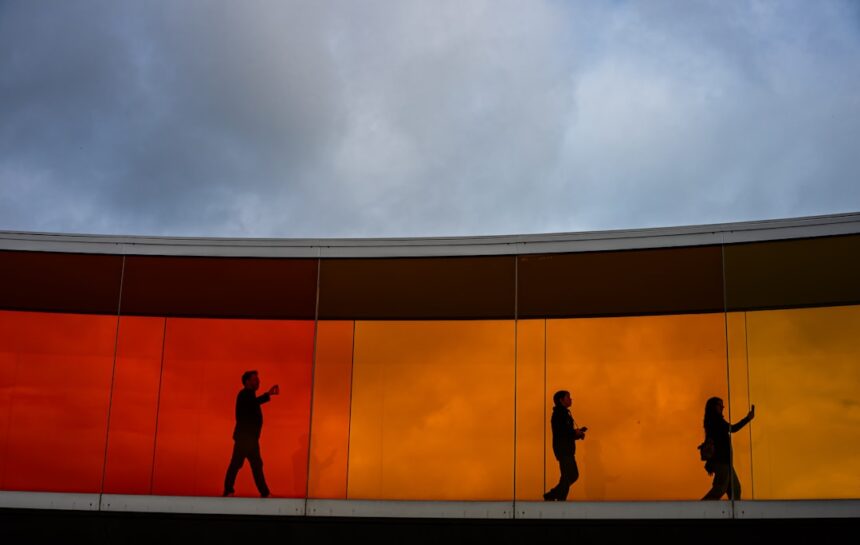
Photo by Julia Taubitz on Unsplash
This article is a curated summary based on third-party sources. Source: Read the original article