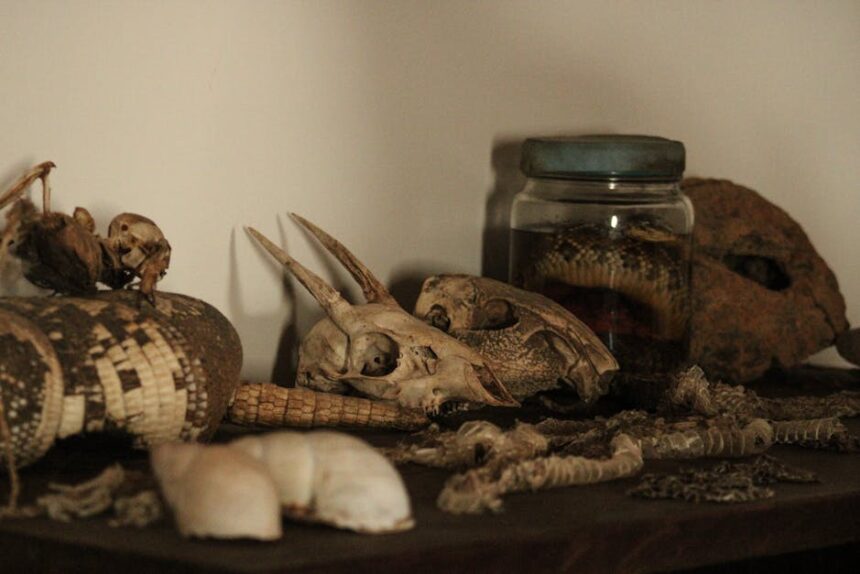
Scientists have examined 46 of Charles Darwin’s original specimens from his HMS Beagle voyage without unsealing their nearly 200-year-old jars, using a portable laser technique to identify the chemical makeup of the preservation fluids inside.
The research, conducted in collaboration between the Science and Technology Facilities Council (STFC), the Natural History Museum in London, and Agilent Technologies, analyzed specimens collected during Darwin’s 1831 to 1836 expedition to the Galápagos Islands. The collection includes mammals, reptiles, fish, jellyfish, and shrimp gathered by Darwin and other naturalists on early scientific expeditions.
How the Technology Works
The method relies on a laser-based technique called Spatially Offset Raman Spectroscopy (SORS), originally developed at STFC’s Central Laser Facility. It works by directing laser light at a sealed jar and measuring subtle shifts in the wavelength of light as it scatters and reflects back through the container wall. Those shifts reveal the chemical signatures of whatever is inside.
The same technology already operates in airport security scanners worldwide. Applying it to museum collections is a new use case, but the underlying physics is identical.
Researchers correctly identified the preservation fluids in approximately 80% of the specimens tested. In another 15% of cases, the technique produced partial identification. The scans also determined whether containers were made from glass or plastic, adding another layer of data for curators tracking how storage practices evolved over time.
What the Darwin Specimens Revealed
The analysis showed that preservation methods varied by organism type and era. Mammals and reptiles were typically treated with formalin before being transferred to ethanol. Invertebrates received a broader mix of treatments, including formalin, buffered solutions, and fluid mixtures containing additives such as glycerol.

That variation is itself historically significant. It tells researchers how scientific preservation practices shifted across different periods and disciplines, information that was previously only accessible by opening the jars and risking damage to irreplaceable material.
Why This Matters for Museums
Museums worldwide hold more than 100 million specimens preserved in liquid. Knowing the exact chemical composition of those fluids is essential: over time, fluids degrade or evaporate, and specimens can suffer quietly inside their sealed containers before anyone detects a problem.
Until now, the only way to check was to open the jar. That process risks evaporation, contamination, and direct environmental exposure to specimens that in some cases have remained sealed for nearly two centuries.
Dr. Sara Mosca of STFC’s Central Laser Facility described the significance directly: “Until now, understanding what preservation fluid is in each jar meant opening them, which risks evaporation, contamination, and exposing specimens to environmental damage. This technique allows us to monitor and care for these invaluable specimens without compromising their integrity.”
Wren Montgomery, a research technician at the Natural History Museum, noted that the work forms part of a broader initiative called NHM Unlocked and represents a concrete step toward transforming how natural history collections are studied and maintained for future generations.
The ability to assess collection health non-invasively gives curators a practical tool to act before deterioration becomes irreversible, protecting not just Darwin’s jars but the millions of specimens housed in natural history institutions across the world.
Photo by Murillo Molissani on Pexels
This article is a curated summary based on third-party sources. Source: Read the original article