A Canadian startup says it can prevent wildfires before they ignite by stopping lightning from striking in the first place. Skyward Wildfire is developing a system using metallic chaff — aluminum-coated fiberglass strands — to reduce the electrostatic buildup inside storm clouds that would otherwise discharge as lightning. The ambition is striking, but the science behind it is uneven and the ecological questions are pointed.
The stakes are real. The 2023 Canadian wildfires produced nearly 500 million metric tons of carbon emissions, and lightning-sparked fires burned 93% of the affected area. As climate change accelerates warming across boreal regions, lightning-caused fires appear to be increasing, particularly in the Arctic, where the planet heats fastest.
How the Technology Works
Lightning forms when snowflakes and tiny ice pellets called graupel collide inside storm clouds. Updrafts separate the charged particles, building an electric differential that eventually discharges. Metallic chaff, when dispersed into those clouds, theoretically acts as a conductor, bleeding off the charge before it can reach discharge levels. Researchers have explored this idea since the 1950s, when the military was already using chaff to disrupt radar.
The results, so far, are mixed. Some research suggests high chaff concentrations may be necessary for meaningful lightning suppression. Early studies were small. And Skyward Wildfire has not released field trial data or published any peer-reviewed research, which makes independent assessment of its claims difficult at this stage.
The Ecological Tension
Even if the method works reliably, scientists and fire ecologists raise a harder question: whether suppressing lightning ignitions is the right intervention at all.
Fire is not inherently destructive. Many ecosystems evolved alongside regular burning, and the most severe wildfires today reflect decades of fuel accumulation driven by suppression policies, not simply too many ignitions. Remove the spark without reducing the fuel load, and the underlying conditions remain unchanged.

Phillip Stepanian, a technical staff member at MIT Lincoln Laboratory’s air traffic control and weather systems group, put it plainly: “Even if we have all of the technical skills to prevent lightning-ignited wildfires, there really still needs to be work on when/where to prevent fires so we don’t exacerbate the fuel accumulation problem.”
Daniel Swain, a climate scientist at the University of California Agriculture and Natural Resources, went further, arguing that technological ignition-prevention solutions “fundamentally misunderstand the problem.” The core issue, in Swain’s view, is not the existence of fire but its growing intensity and its collision with human communities, driven by human-caused factors. Preventing ignitions does not address any of that.
What Skyward Says
The company is not proposing to eliminate lightning or stop every fire. Nicholas Harterre, who oversees government partnerships at Skyward, said the company “does not intend to eliminate all wildfires and supports prescribed and cultural burning, natural fire regimes, and proactive forest management.” The goal, he said, is to reduce ignition likelihood on a limited number of extreme-risk days.
That narrower framing is more defensible than blanket suppression. But it still depends on a targeting judgment — knowing which days and which landscapes genuinely warrant intervention — that requires ecological expertise alongside the engineering.
Prescribed burns remain one of the most evidence-backed tools for reducing catastrophic fire risk, yet they continue to face funding shortfalls and regulatory friction. The appetite for technical fixes does not always translate into support for slower, less visible land management work that addresses the conditions fires need to grow.
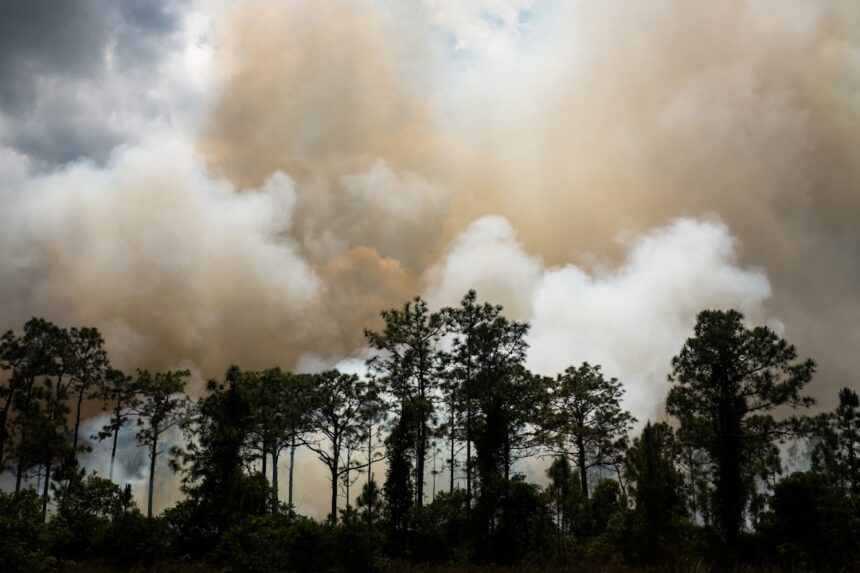
Photo by Ryan Arnst on Unsplash
This article is a curated summary based on third-party sources. Source: Read the original article