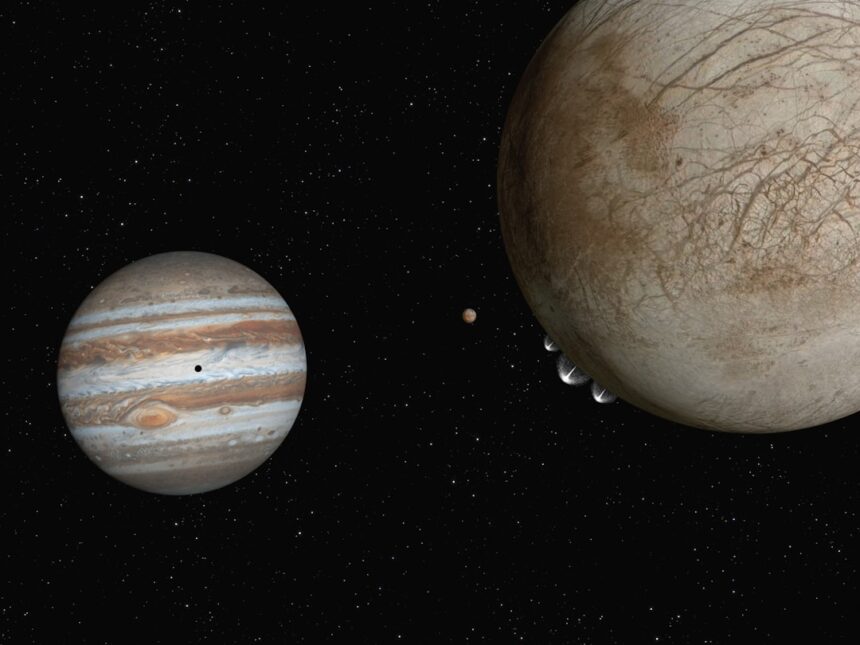
Jupiter’s largest moons may have formed already carrying the chemical building blocks associated with life, according to new research from an international team that included scientists from the Southwest Research Institute (SwRI). The findings, published across two companion papers in The Planetary Science Journal and Monthly Notices of the Royal Astronomical Society, suggest that complex organic molecules reached moons like Europa, Ganymede, and Callisto during the earliest stages of their formation.
What the Research Found
The team modeled how complex organic molecules (COMs), carbon-based compounds also containing oxygen and nitrogen that are considered essential precursors to biology, could have assembled within the swirling disk of gas and dust surrounding the young Sun. Using simulations that combined disk evolution with particle transport models, researchers tracked the physical and chemical journey of icy grains through both the protosolar nebula and Jupiter’s own circumplanetary disk.
The key finding: in certain modeled scenarios, nearly half of the icy particles transported freshly created organic compounds into the region where Jupiter’s moons were forming, without those compounds being chemically broken down in the process.
“By combining disk evolution with particle transport models, we could precisely quantify the radiation and thermal conditions the icy grains experienced,” said Dr. Olivier Mousis of SwRI’s Solar System Science and Exploration Division, lead author of one of the two studies. “The results showed that COM formation is possible in both the protosolar nebula environment and Jupiter’s circumplanetary disk.”
How Organic Molecules Form in Space
Laboratory work has already established that COMs can form when icy dust grains containing methanol, or mixtures of carbon dioxide and ammonia, are exposed to ultraviolet light or mild heating. Both conditions are common in protoplanetary disks around young stars. The researchers applied this chemistry to the specific environment of the early solar system, tracing how those conditions played out across both the broader nebula and the smaller disk that eventually produced Jupiter’s moons.
The simulations also pointed to COM formation occurring closer to Jupiter itself. Portions of Jupiter’s circumplanetary disk apparently reached temperatures high enough to trigger the relevant chemical reactions independently, meaning the moons may have drawn organic material from more than one source.

Why Europa Matters Most
Europa has long been a focus of astrobiological interest because of the liquid water ocean believed to sit beneath its icy surface. The prospect that organic molecules were woven into the moon’s fabric from the moment it formed adds another dimension to that interest. Ganymede and Callisto, both also thought to harbor subsurface oceans, appear to have received similar material under this model.
The research team brought together scientists from SwRI, Aix-Marseille University in France, and the Institute for Advanced Studies in Ireland. Their approach of reconstructing the full physical and chemical history of icy particles, from the protosolar nebula through delivery into growing moons, offers a more complete picture of how the Jovian system acquired its molecular inventory.
The work does not confirm the presence of life, or even the conditions for it today. What it does establish is that the chemical starting materials had a plausible path into the moons from the very beginning.
Photo by NASA Hubble Space Telescope on Unsplash
This article is a curated summary based on third-party sources. Source: Read the original article