Europe’s Copernicus Sentinel-2 satellite mission has captured a striking orbital image of south-central Morocco, revealing the full scale of the Ouarzazate solar power station alongside the Anti-Atlas Mountains and the city of Ouarzazate. The European Space Agency released the image on February 20, 2026, taken during January 2026.
What the Image Shows
The false-color photograph was processed using Sentinel-2’s near-infrared channel, which causes vegetation to appear in vivid red. Plants reflect more near-infrared light than green light, producing that distinctive coloration. The result is a sharp visual contrast between the desert terrain, the red-tinted vegetation, and the deep blue of the El Mansour Eddahbi Reservoir.
Because the image was captured during Morocco’s rainy season, the rivers and tributaries feeding the reservoir are clearly visible, tracing thin veins across the landscape. The northern edge of the Anti-Atlas Mountains sits just below the city, while the upper portion of the frame is dominated by open desert.
The Solar Station’s Scale
The Ouarzazate facility, officially known as Noor Power Station (Arabic for “light”), covers more than 7,400 acres (3,000 hectares). That footprint is roughly equivalent to the size of the city of Ouarzazate itself. It holds the distinction of being the world’s largest concentrated solar power facility.
From orbit, the sheer expanse of the installation is impossible to miss. It dominates the desert floor in a way that few human-built structures do when viewed from space.
About the Sentinel-2 Mission
The Copernicus Sentinel-2 mission operates three satellites in low Earth orbit. Sentinel-2A launched in June 2015, Sentinel-2B followed in March 2017, and Sentinel-2C joined them in orbit in 2024. Together, the trio provides continuous Earth observation coverage, supplying imagery used across environmental monitoring, agriculture, and land-use tracking.
The mission’s near-infrared imaging capability is what makes photographs like this one particularly informative, turning subtle differences in surface reflectivity into distinct, readable color contrasts. What might appear as featureless terrain in standard optical imagery becomes a detailed map of land cover and water distribution.
Morocco’s Energy Landmark
The Noor Power Station represents one of the most ambitious renewable energy projects on the African continent. Concentrated solar power works differently from conventional photovoltaic panels: it uses mirrors to focus sunlight onto a receiver, generating heat that drives turbines to produce electricity. The technology allows for thermal energy storage, enabling power generation to continue after sunset.
Morocco has positioned the facility as a cornerstone of its long-term energy strategy, with ambitions to export solar-generated electricity to European markets via undersea cable links. The Sentinel-2 image, taken from hundreds of kilometers above Earth’s surface, illustrates just how physically dominant that ambition looks from the outside.
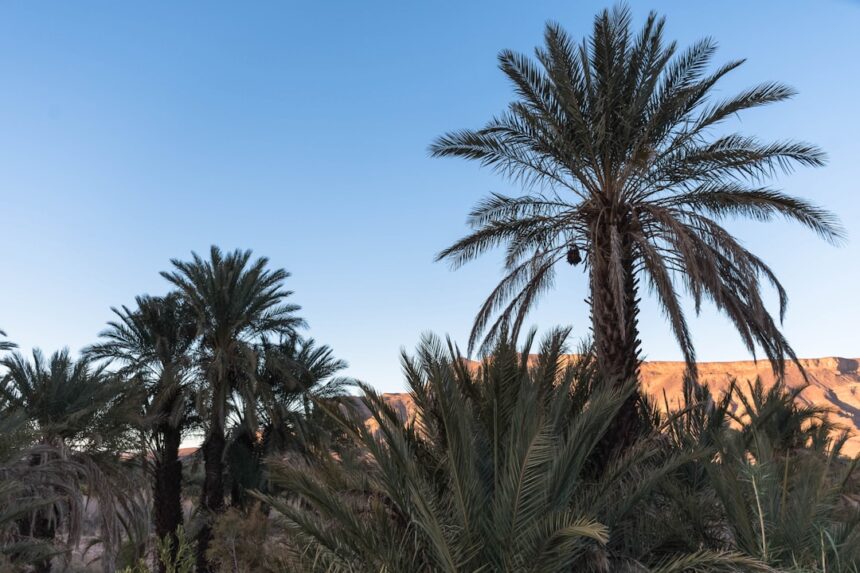
Photo by Desert Morocco Adventure on Unsplash
This article is a curated summary based on third-party sources. Source: Read the original article