Observations from the Dark Energy Spectroscopic Instrument (DESI) suggesting that dark energy may be weakening over time have reignited debate over some of cosmology’s most contested ideas, including cyclic universes and string theory’s hidden dimensions.
The standard model of cosmology, known as lambda-CDM, treats dark energy as a cosmological constant: a fixed value representing the energy density of empty space. If the DESI data holds up under scrutiny, that foundational assumption breaks down, and physicists will need to replace it with something else entirely.
A Universe That Bounces Back
Paul Steinhardt, a physicist at Princeton University and a long-standing critic of inflation theory, argues that the DESI findings align with predictions from cyclic cosmology. In this model, the universe does not expand indefinitely. It expands, slows, contracts, and then bounces into a new cycle.
That mechanism requires dark energy to decay. “It must be some kind of decaying dark energy that stops accelerating the expansion of the universe, starts decelerating it and then eventually causes contraction, leading to a bounce and a new cycle,” Steinhardt said. The DESI data, which points to a slowdown in the acceleration of cosmic expansion, fits the first part of that sequence.
Steinhardt has been skeptical of inflation for years, calling it a theory that “doesn’t work” because it requires unlikely initial conditions, is too flexible, and implies a multiverse that many physicists find difficult to accept. His response to the new data is measured: “I tend to be very conservative and very patient. What I would say, however, is that now the game is afoot.”
That said, the DESI results do not constitute evidence for cyclic models. Measurement errors remain possible, and dark energy could weaken without ever triggering a contraction.

String Theory Gets a Foothold
The implications extend into string theory, which holds that matter and forces emerge from tiny vibrating strings compactified into extra spatial dimensions not accessible to current observation. String theory gained traction in the 1980s as a candidate for reconciling quantum mechanics and general relativity, but theorists have struggled for decades to construct models consistent with a small, positive cosmological constant.
In 2018 and 2019, Cumrun Vafa at Harvard University and colleagues developed what are called the Swampland conjectures. These proposals attempt to identify which theoretical descriptions of particles, forces, and spacetime can actually emerge from a consistent theory of quantum gravity, and which cannot. Their conclusion: dark energy as a cosmological constant is incompatible with that framework.
If dark energy is instead dynamic and decaying, as the DESI data tentatively suggests, that finding aligns with the Swampland picture and, by extension, lends indirect support to string theory’s broader architecture, including those hidden extra dimensions.
Eric Linder, a physicist and cosmologist at the University of California, Berkeley, described the moment directly: “There certainly are very, very interesting possibilities for changing a lot of physics.”
What Comes Next
The DESI findings remain preliminary. Researchers are actively examining whether systematic errors in the measurements or analysis could explain the apparent signal. Further data collection and independent verification will determine whether decaying dark energy is a genuine feature of the universe or an artifact of current instrumentation.
If confirmed, the consequences reach beyond revising a single parameter. They could reshape how physicists think about the geometry of spacetime, the ultimate fate of the universe, and whether reality contains more dimensions than the four we can measure.
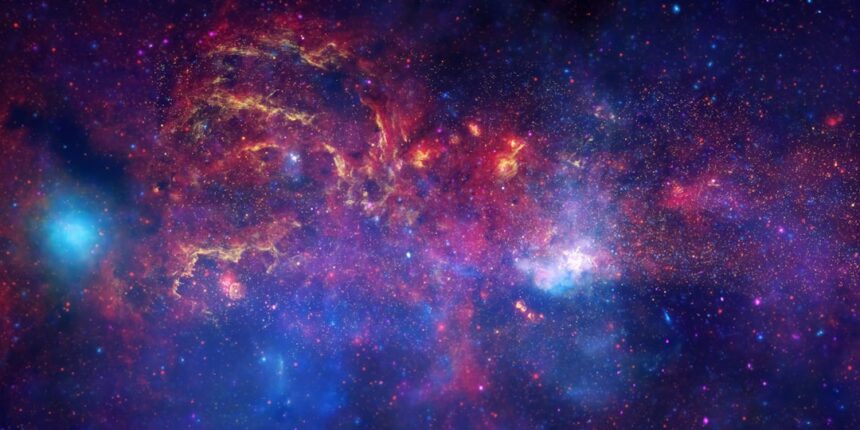
Photo by NASA Hubble Space Telescope on Unsplash
This article is a curated summary based on third-party sources. Source: Read the original article