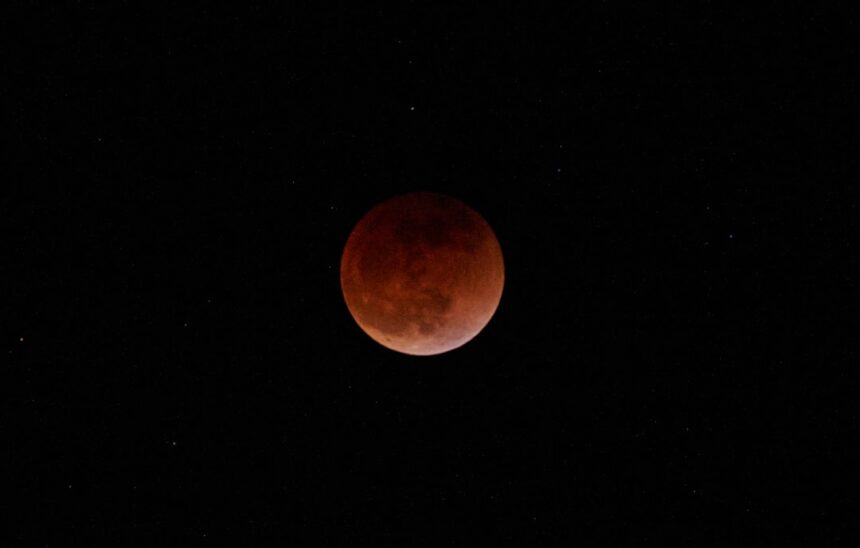
On March 3, 2026, Earth’s shadow will completely swallow the full Worm Moon for 58 minutes, turning it a copper-reddish color visible across much of the world. The naked eye will catch the spectacle, but binoculars or a telescope will reveal considerably more: the curved edge of Earth’s shadow creeping across crater rims, mountain ranges, and ancient lava plains drenched in refracted sunlight.
This will be the first total lunar eclipse since September 7-8, 2025, and the last anywhere on Earth until New Year’s Eve in 2028. A deep 93% partial eclipse arrives on August 27, 2026, but true totality will not return to North America for nearly three years after March 2026. The full event on March 3 spans 5 hours and 38 minutes, including penumbral and partial phases.
Timing and Visibility
North American observers will need to set early alarms. Totality runs from 5:04 a.m. to 6:02 a.m. CST. Viewers in eastern locations will see the moon set during totality, while those farther west will catch the event higher in the sky. Regardless of location, starting observations at least 75 minutes before totality allows watchers to follow Earth’s shadow as it gradually crosses the bright lunar disk.
What Binoculars Reveal
Binoculars represent the most accessible upgrade. During the partial phases, even a basic pair will show the precise curve of Earth’s shadow as it moves across the surface. As totality deepens and the moon dims, the lunar maria — vast lava-filled plains — become darker and more defined. Lunar mountains in the southern highlands emerge, wrapped in color.
For beginners, 8×42 or 10×50 models offer the best balance of magnification, aperture, and portability. They frame the entire moon comfortably and remain lightweight enough to hold steady. Stepping up to 12×50 or 15×70 binoculars brings the surface closer, but increased magnification amplifies handshake. Mounting them on a camera tripod with an L-shaped adapter largely solves that problem. Image-stabilized binoculars handle it electronically, though at significantly higher cost.
During totality itself, binoculars allow observers to distinguish between patches of crimson, copper, and pinkish tones as the moon moves through sunlight refracted around Earth’s atmosphere. These color variations shift even within the 58-minute totality window.

The Case for a Telescope
A telescope pushes the experience further. At higher magnification, individual craters become sharp and identifiable, and the gradient of color across the lunar disk grows far more pronounced. The eclipsed moon is dim enough during totality to observe comfortably through an eyepiece without filters, making this one of the few lunar events where a telescope does not overwhelm the eye.
The core takeaway is straightforward. The eclipse works at every level of equipment, from bare eyes to serious optics. But the observers who will remember March 3, 2026 most vividly are those who point even a modest pair of binoculars at the sky before dawn and watch Earth’s shadow do its slow, unhurried work.
Photo by Jim Strasma on Unsplash
This article is a curated summary based on third-party sources. Source: Read the original article