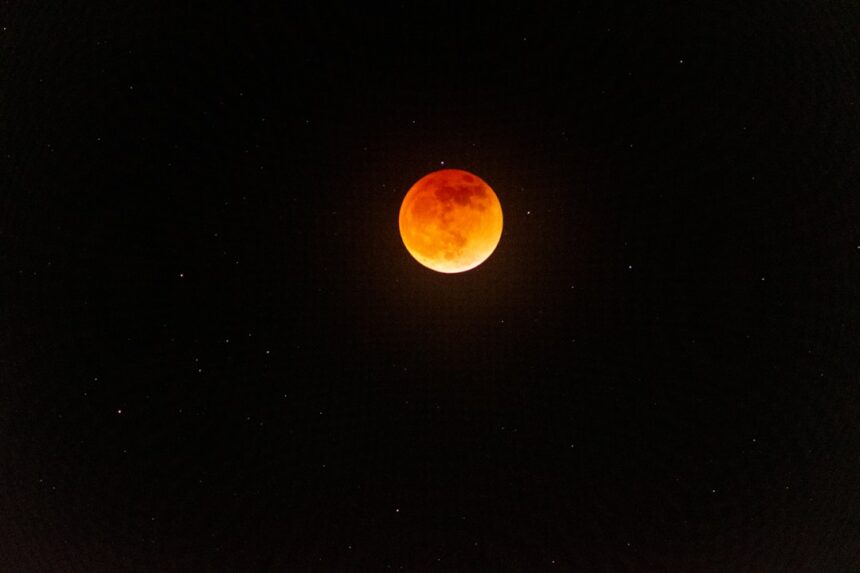
A total lunar eclipse visible across much of the United States is set for Tuesday morning, March 3, but cloud cover will block views for a significant portion of the country. The blood moon phase begins at 6:03 a.m. Eastern Time, or 3:03 a.m. Pacific Time, and totality lasts 58 minutes.
Roughly half the nation stands to catch at least some glimpse of the moon passing through Earth’s dark shadow. The other half faces weather conditions ranging from frustrating to completely obstructive.
Where Skies Look Clear
The most favorable conditions are concentrated in specific pockets. Southeast New England, much of the Florida peninsula, the northern Rockies, the Southwest deserts, Nevada, and most of California carry the best overall outlook for unobstructed viewing.
For observers in the Northeast corridor watching clouds edge in overnight, the best strategy is to move east. Eastern Massachusetts, southeast New Hampshire, and southern Maine offer the strongest prospects for clear skies ahead of the advancing cloud shield. The protective dome of high pressure that will keep Tuesday evening skies clear over southeast New York shifts rapidly eastward as the night progresses, pulling fair conditions toward the coast.
Where Clouds Will Be a Problem
A quasi-stationary front stretching from the Central Plains through the Upper Midwest and east to the Mid-Atlantic will drag a wide band of clouds and wet weather across a large swath of the country. The heaviest rain is expected over parts of eastern Kansas, northeastern Missouri, central Illinois, and west-central Indiana.
Additional trouble spots include portions of Utah, Wyoming, and Colorado, where light rain and snow are possible. A cold front dropping southward from south-central Canada will affect the Northern Plains through the upper Great Lakes region.

Along the Southeast, an inverted trough of low pressure developing near the Carolina coast will pull moist Atlantic air inland, spreading widespread cloudiness across the Piedmont region. Near the Pacific coast of Washington, Oregon, and northern California, a marine layer of low clouds will likely sit in place at eclipse time.
Reading the Forecast Map
NOAA’s National Digital Forecast Database has produced a sky cover percentage map valid for Tuesday at 7 a.m. EST. It breaks viewing conditions into three tiers:
- Good: Sky cover of 30% or less, ranging from clear to scattered clouds.
- Fair: Sky cover between 30% and 70%, with likely breaks offering periodic views of the moon.
- Poor: Heavy cloud cover with little to no chance of seeing the eclipse.
The Timing Problem for the Northeast
For New York, New Jersey, Pennsylvania, and much of New England, the eclipse timing is particularly unfortunate. Tuesday evening skies in those areas will likely be clear and moonlit under a large high-pressure dome. But that system exits eastward overnight, and cloud cover moves in from the west ahead of the 6:03 a.m. totality window.
How much of the blood moon Northeast observers actually see depends entirely on how quickly that cloud shield advances before dawn.
Photo by Elesban Landero Berriozábal on Unsplash
This article is a curated summary based on third-party sources. Source: Read the original article