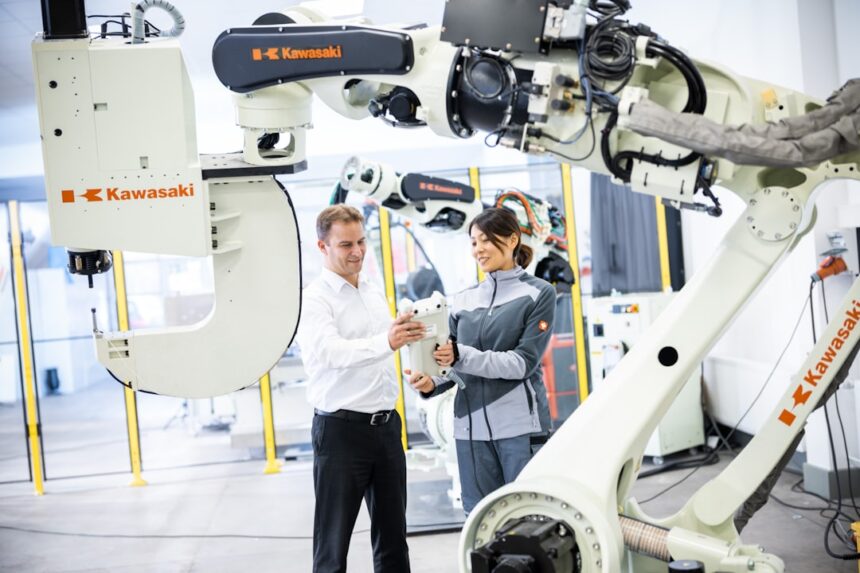
Wendy Tan White had a specific quote ready when describing what her company is now meant to become. “Sundar Pichai said this is the Android of robotics,” she told reporters, noting that the Google CEO had worked directly on both Chrome and Android before taking the top job. That framing — not “platform,” not “ecosystem,” but Android — signals exactly what the company believes it has built.
On February 25, Intrinsic officially joined Google, ending its run as a standalone Alphabet subsidiary. No acquisition price was disclosed. The firm will operate as a distinct group inside Google, working alongside Google DeepMind and drawing on Gemini AI models and Google Cloud infrastructure.
Intrinsic spent five years developing inside Alphabet’s X — the same moonshot division that produced Waymo and Wing — before graduating to an independent Alphabet company in 2021. Its original problem statement was specific: industrial robots have gotten cheaper to build, but programming them remains brutally difficult, often demanding hundreds of hours of manual coding by specialist engineers, with the workload shifting depending on the robot involved.
One platform, no code required
The company’s answer is Flowstate, a web-based platform designed to let users build robotic applications without writing thousands of lines of code. According to the announcement, it is designed to be hardware-, software-, and AI-model-agnostic — closer to an operating layer than a standalone product.
That positioning matters, because the moves surrounding this integration form a deliberate pattern. In November, Google DeepMind hired the former CTO of Boston Dynamics. Last month, Google partnered with Boston Dynamics to embed Gemini into Atlas humanoid robots built for manufacturing environments. Now Intrinsic sits inside Google’s core. The result is a single organization that can offer manufacturers AI reasoning from DeepMind, robotics development software from Intrinsic, and cloud deployment through Google Cloud — assembled under one roof in a way no direct competitor has replicated cleanly.
Intrinsic also came with acquisitions of its own. In 2022, it bought Open Source Robotics Corp., the for-profit arm of the organization behind the Robot Operating System (ROS). In October 2025, the firm signed a strategic partnership with Foxconn to develop general-purpose intelligent robots targeting full factory automation in electronics manufacturing.

The market Google is after
McKinsey projects the general-purpose robotics market could reach US$370 billion by 2040. That figure gives context to the consolidation happening inside Google — this is not a cleanup of legacy moonshots but a coordinated move into a market that is still largely unsolved at scale.
White framed the integration around production economics and what she described as truly advanced manufacturing becoming accessible once Google’s full infrastructure sits behind it. The integration, the company says, will combine advanced reasoning, perception, and learning capabilities with industrial-grade robotics software, enabling machines to interpret sensor data, adapt to dynamic environments, and handle complex tasks.
The claim is large. The infrastructure behind it, for the first time, is not.
Photo by Natalia Dziubek on Unsplash
This article is a curated summary based on third-party sources. Source: Read the original article