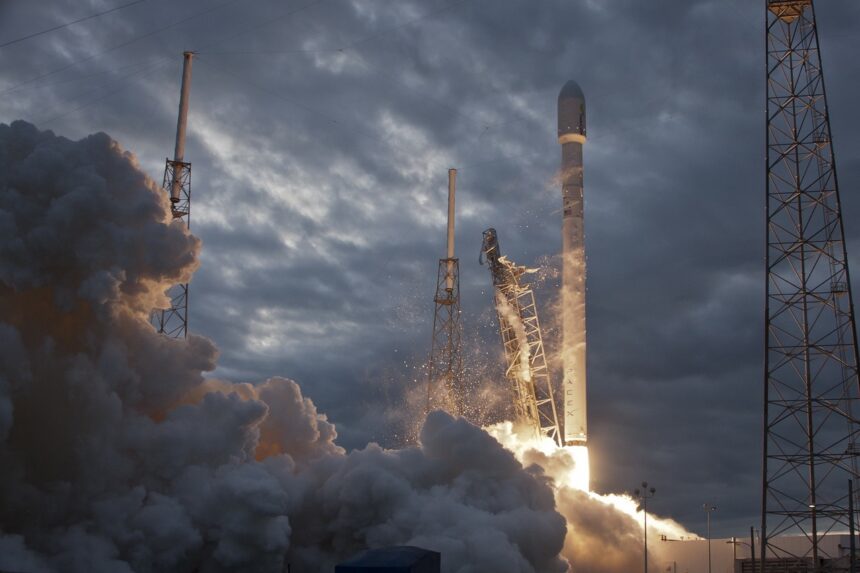
Japan’s commercial launch sector has now suffered back-to-back setbacks within months, compounding pressure on the country’s broader ambitions to build independent access to orbit.
Space One‘s Kairos small rocket self-destructed 69 seconds after liftoff, terminating its flight at approximately 18 miles (29 kilometers) above the Pacific Ocean. It was the company’s third consecutive failure, and it comes just three months after a separate failure of Japan’s flagship H3 rocket — leaving domestic launch options increasingly thin at a moment when Japan is seeking to reduce dependence on American rockets amid growing space security concerns tied to China.
What makes the Kairos failure particularly unusual is its apparent cause. According to the announcement, Space One vice president Nobuhiro Sekino told a press conference that “no significant abnormalities were found in the flight or onboard equipment” before the self-destruction — pointing toward a malfunction in the rocket’s autonomous flight termination system rather than a primary vehicle failure. That is a rare failure mode, and one that raises distinct technical questions separate from propulsion or structural performance.
The Kairos rocket stands approximately 59 feet (18 meters) tall, uses three solid-fueled boost stages and a liquid-fueled upper stage, and is designed to carry payloads of up to 330 pounds (150 kilograms) into Sun-synchronous orbit. The vehicle launched from Space One‘s spaceport on the southern coast of Honshu.
Artemis Restructured
Elsewhere, NASA‘s restructuring of the Artemis program reconfigures the near-term mission architecture in ways that reduce technical risk while deferring the first actual lunar landing. The Artemis III mission has been redefined as a low-Earth orbit mission: the Space Launch System and Orion spacecraft will rendezvous with one or both of the program’s human-rated lunar landers just a few hundred miles above Earth, with no cryogenic propellant transfer required. The first lunar landing attempt moves to Artemis IV.
The plan also cancels the development of a new upper stage for SLS, replacing it with a commercial alternative — almost certainly United Launch Alliance‘s Centaur stage — with expected cost savings. The restructuring also eases the near-term pressure on SpaceX and Blue Origin to demonstrate cryogenic refueling in orbit on an accelerated timeline.

Sentinel Costs Continue to Climb
The US Air Force’s LGM-35A Sentinel intercontinental ballistic missile program remains on track for its first test flight next year, with initial operational capability targeted for the early 2030s. The missile is set to replace the Minuteman III fleet, which has been in service since 1970. The program’s projected cost has grown from $78 billion to an official estimate of $141 billion — a figure already described as out of date following the decision to construct entirely new silos rather than adapt existing Minuteman III facilities.
Engineers determined that modifying the aging silos would take too long and cost too much. The new construction plan calls for 450 hardened underground silos across Colorado, Montana, Nebraska, North Dakota, and Wyoming, along with 24 new forward launch centers, 3 centralized wing command centers, and more than 5,000 miles of fiber connections. No firm timeline or final cost figure for the silo construction has been disclosed.
Photo by Pixabay
This article is a curated summary based on third-party sources. Source: Read the original article