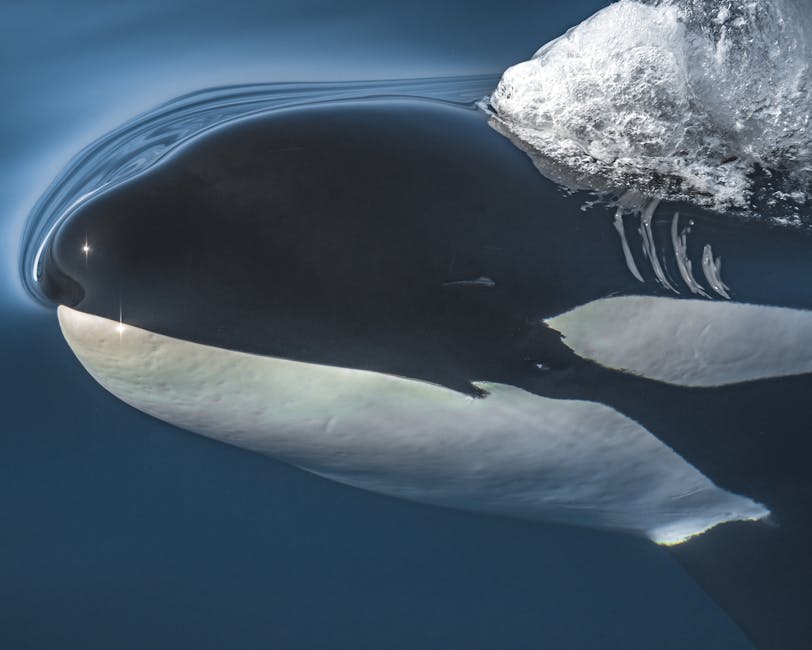
Killer whale fins found on a Russian beach carry tooth marks from other orcas, offering the first physical evidence that the animals practice cannibalism — and potentially explaining why some pods live in unusually large family groups.
The fins were discovered on Bering Island in eastern Russia by Sergey Fomin, a researcher at the Pacific Institute of Geography, in August 2022 and again in July 2024. The second fin, slightly larger, came from a young male. Both bore the same characteristic tooth marks seen on prey animals previously killed by Bigg’s orcas. According to the study, published Feb. 24 in the journal Marine Mammal Science, fins are typically discarded by killer whales because they are tough and obstruct access to the muscle and blubber beneath.
Genetic testing identified both fins as belonging to southern resident orcas — a population that inhabits waters near Washington and British Columbia and is considered distinct from the Bigg’s orcas believed responsible for the attacks.
Two Types, One Ocean
The North Pacific hosts two broadly different killer whale types sharing the same range. Resident orcas live in large, stable family groups and eat fish. Bigg’s orcas are more transient, travel in smaller groups, and hunt marine mammals including whales, dolphins, and seals. The prevailing assumption had been that the two types largely avoided each other.
Olga Filatova, a whale researcher at the University of Southern Denmark and the study’s lead author, told the report’s source that Fomin initially assumed the fin belonged to a beaked whale or a minke — species previously found with identical bite patterns from Bigg’s orcas. “He immediately thought, ‘Oh, this looks familiar,'” she said. The orca identification came as a surprise.
By the second discovery, the pattern was harder to dismiss. “At that moment, I started thinking that this is a pattern,” Filatova said.

Predation as a Driver of Social Structure
The researchers propose that intermittent predation by Bigg’s orcas may help explain why resident orcas form tight, multigenerational family bonds — a social structure unusual in its scale even among highly social animals. Grouping in large numbers is a well-documented defensive response to predation pressure across many species.
“So, it looks like this defense strategy is really working,” Filatova said.
Orcas have long been described as apex predators with no natural enemies, but aggression between individuals and groups is documented. In 2016, Bigg’s orcas were observed chasing and killing a newborn, an event researchers interpreted as potentially related to reproductive competition.
Filatova was careful to frame the cannibalism finding within limits. “At least now we know that cannibalism happens, but I think it is not super common,” she said. The study says the fins represent opportunistic evidence rather than proof of frequent behavior — physical remains from events that, in open ocean, would otherwise leave no trace.
Photo by Adam Ernster on Pexels
This article is a curated summary based on third-party sources. Source: Read the original article