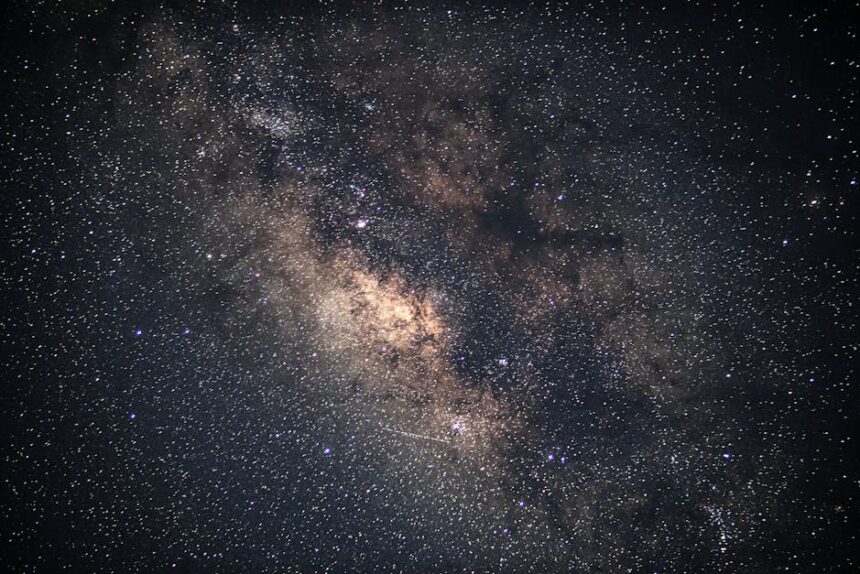
Three full Moons, side by side. That is how wide the new ALMA image of the Milky Way’s core stretches across the sky — and it is the largest single mosaic the observatory has ever produced.
The image targets a region called the Central Molecular Zone, or CMZ, which spans more than 650 light-years around the supermassive black hole at the galaxy’s center. For the first time, every cold molecular gas structure across this entire area has been mapped at this level of precision — from massive formations dozens of light-years wide down to small clouds wrapped around individual stars.
Cold molecular gas is the raw material from which stars are built. Mapping it here matters because the CMZ is not a quiet nursery. It is one of the most extreme environments in the galaxy, dense with turbulence, radiation, and gravitational forces that dwarf anything found in the Milky Way’s outer regions.
What the Survey Found
“It’s a place of extremes, invisible to our eyes, but now revealed in extraordinary detail,” says Ashley Barnes, an astronomer at the European Southern Observatory in Germany and a member of the research team. The observations come from a project called ACES — the ALMA CMZ Exploration Survey — built specifically to study this cold gas and what it produces.
The chemical inventory alone surprised researchers. The survey detected dozens of distinct molecules, ranging from relatively simple compounds such as silicon monoxide to more complex organic substances including methanol, acetone, and ethanol. That variety points to a chemical environment far richer than expected for such a violent setting.
The gas itself moves through elongated filaments, funneling inward toward dense clumps where star formation takes hold. Astronomers track this process reasonably well in calmer parts of the galaxy. Near the galactic center, the same physics operates under far harsher conditions.

Stars That Live Fast
“The CMZ hosts some of the most massive stars known in our galaxy, many of which live fast and die young, ending their lives in powerful supernova explosions, and even hypernovae,” says Steve Longmore, professor of astrophysics at Liverpool John Moores University and leader of the ACES survey.
The reason that matters extends well beyond the Milky Way. According to the announcement, the CMZ closely resembles conditions found in galaxies during the early universe, when star formation was happening at its most intense and chaotic. Studying this region now offers a nearby laboratory for understanding how entire galaxies assembled themselves billions of years ago.
“By studying how stars are born in the CMZ, we can also gain a clearer picture of how galaxies grew and evolved,” Longmore says. “We believe the region shares many features with galaxies in the early Universe, where stars were forming in chaotic, extreme environments.”
The dataset was assembled at ALMA‘s facility in Chile’s Atacama Desert, operated by ESO and its international partners. The observatory’s role here was one of scale — stitching together enough individual pointings to cover a portion of the galactic center that has never before been surveyed in a single, coherent map at this resolution. “It is the only galactic nucleus close enough to Earth for us to study in such fine detail,” Barnes notes.
Photo by Nothing Ahead on Pexels
This article is a curated summary based on third-party sources. Source: Read the original article