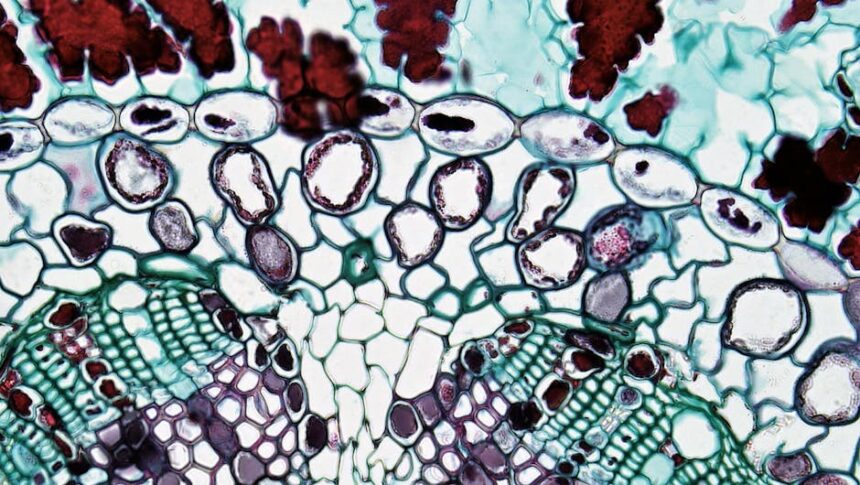
The pineal gland sits at the base of the vertebrate brain, long dismissed as a vestigial curiosity. It may actually be a fossil of the moment our eyes were reinvented.
A theoretical synthesis published in Current Biology proposes that vertebrate eyes — including human eyes — did not descend directly from the paired lateral eyes of early bilaterian animals. Instead, according to the study’s authors from the University of Sussex and Lund University, they were rebuilt from a single, centrally located light-sensitive organ after the original paired eyes were lost entirely.
“Vertebrate eyes are so fundamentally different from the lateral eyes of other animal groups,” says Dan-Eric Nilsson, senior author and eye evolution specialist at Lund University. The core distinction, he explains, comes down to the photoreceptor cells doing the work. Most invertebrates — insects, crustaceans, cephalopods — rely on rhabdomeric photoreceptor cells for image-forming vision. Vertebrates instead use ciliary cells, known as rods and cones, for that function. In most other animals, ciliary cells regulate biological clocks. They don’t form images.
Vertebrates ended up with both types in the same organ. In the vertebrate retina, ciliary cells handle vision while rhabdomeric cells monitor ambient light and relay signals to higher brain centers. The study argues the rhabdomeric arrangement represents the original ancestral condition, inherited from the common ancestor of all bilaterally symmetrical animals.
The burrowing detour
The proposed explanation for how vertebrates diverged starts with a lifestyle change. After the bilaterian lineage split — one branch producing invertebrates, the other leading to deuterostomes, which include chordates and eventually vertebrates — the ancestral deuterostome appears to have adopted a sedentary, burrowing existence on the seafloor.
“Neural tissue in general is very expensive to maintain and function,” says George Kafetzis, research fellow at the University of Sussex. Paired lateral eyes, useful for a mobile animal scanning its surroundings, would have become a metabolic burden for something partially buried in sediment. The lineage, the study suggests, gradually lost them.

But some descendants of that burrowing ancestor returned to open water. For a free-swimming animal, two eyes matter enormously — comparing light input from each side allows the nervous system to steer. The rhabdomeric lateral eyes were gone by then. What remained was a single, median light-sensing organ that had survived because even a buried animal needs to distinguish day from night, open water from shadow.
One eye becomes two
“We think that in this early deuterostome, the median eye contained both ciliary and rhabdomeric cells,” Kafetzis explains. That single cyclopean organ, the hypothesis holds, carried both cellular lineages forward. When selective pressure favored paired eyes again, evolution worked with what was available — reshaping that central structure into two new lateral eyes, this time built on a ciliary foundation rather than a rhabdomeric one.
The pineal complex may preserve evidence of that process. Scientists have long noted structural similarities between the retina and the pineal organ, leading to the longstanding suspicion that both evolved from a single ancestral structure. Under this framework, the pineal is not merely a leftover — it is the closest living trace of the cyclopean eye that vertebrate vision was reconstructed from.
Photo by Fayette Reynolds M.S. on Pexels
This article is a curated summary based on third-party sources. Source: Read the original article