Brown dwarfs occupy an awkward position in stellar physics — too massive to be planets, too light to sustain nuclear fusion — and they remain difficult to detect precisely because they emit so little light. A newly released image of nebula RCW 36 offers astronomers a promising environment to study them in greater numbers.
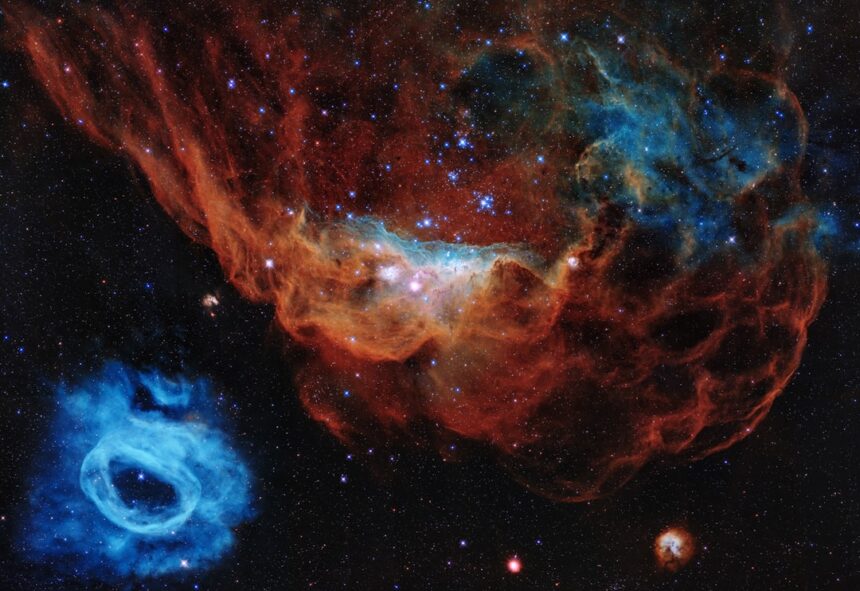
Using the Very Large Telescope (VLT) and its instrument HAWK-I, astronomers captured a detailed image of RCW 36, a glowing nebula situated approximately 2,300 light-years from Earth in the Vela constellation. According to the announcement, the nebula’s structure — dark clouds and filaments of gas and dust forming its upper portion, with a blue stellar nursery packed with newborn massive stars below — traces the outline of a hawk in flight, a coincidence made sharper by the name of the instrument that recorded it.
What the Image Actually Reveals
The visual resemblance to a bird of prey is incidental to the scientific interest. Astronomers believe RCW 36 is densely populated with brown dwarfs — dim bodies that form through the same mechanism as stars, collapsing from patches of overdense, cool gas, but never accumulate sufficient mass to reach the core temperatures and pressures required to fuse hydrogen into helium. That fusion process is the defining threshold of a main-sequence star, and brown dwarfs fall short of it.
The stellar nursery visible in the lower portion of the image, rich with massive blue stars, provides the broader formation context. The region’s conditions make it a candidate for studying how brown dwarfs emerge alongside conventional stars — and in what proportions.
Brown Dwarfs as the Primary Focus
The report notes that it is the brown dwarf population, not the newborn blue stars, that most interests the scientists examining this nebula. Brown dwarfs have long carried the informal label “failed stars,” though the designation is descriptive rather than pejorative — they represent an outcome of stellar formation where the raw material simply ran out before the ignition threshold was crossed.
Their low luminosity makes them inherently difficult to catalog, and dense star-forming regions like RCW 36 — where the conditions for their creation are well understood — give researchers environments where concentrations may be high enough to study systematically. The VLT‘s sensitivity, combined with HAWK-I‘s infrared capabilities, makes the instrument well suited to detecting objects that emit primarily at those wavelengths.

The hawk silhouette visible in the nebula’s gas and dust structure, captured by an instrument named HAWK-I, is the kind of nominal coincidence that rarely survives scrutiny — in this case, it does.
Photo by NASA Hubble Space Telescope on Unsplash
This article is a curated summary based on third-party sources. Source: Read the original article