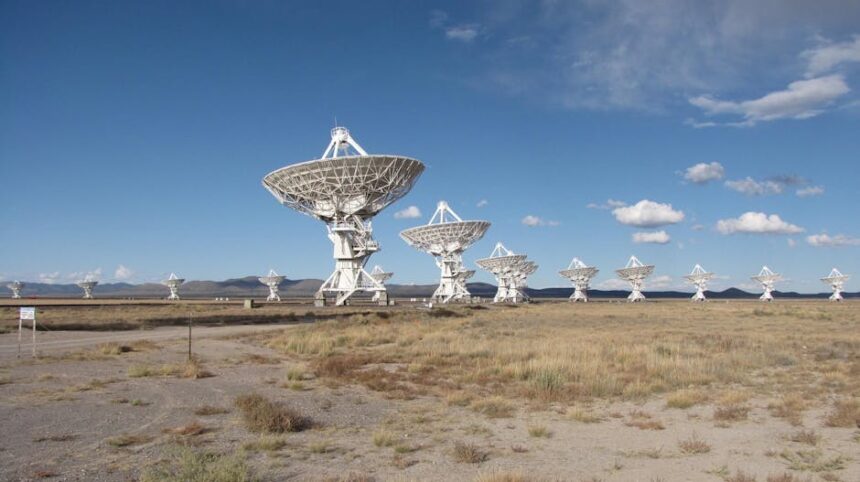
Solar wind may have been distorting alien radio signals for decades, causing them to slip past SETI detection systems entirely unnoticed.
Researchers Vishal Gajjar and Grayce Brown at the SETI Institute calculated how plasma winds from stars affect radio transmissions. They used data from spacecraft in our own solar system, then extrapolated the effect to other stellar environments. According to the report, a 100 megahertz signal could be broadened by as much as 100 hertz — enough to “fall below traditional detection thresholds.”
A space weather event can increase that broadening by several orders of magnitude.
The Wrong Kind of Signal
Traditional SETI searches focused on narrow-band radio signals — sharp, distinct transmissions in a tight frequency range. That assumption may have been flawed from the start.
Simon George at the SETI Institute says the idea that an intelligent civilisation would transmit narrow-band signals is “becoming dated.” He points to how Earth’s own communications have evolved since the 1960s — shifting sharply toward broadband and spread-spectrum techniques, which carry far more information. Earth itself, he notes, was a strong narrowband source in the 1960s but is “much less so now with a continuing downward trend.”
George frames it this way: treat Earth as an exoplanet viewed by an alien civilisation. What they would detect today looks nothing like what SETI has been hunting for.

Higher Odds, Still Long Odds
John Elliott at the University of St Andrews sees the findings as reason for optimism rather than disappointment. Signal distortion is only part of what hampered previous searches — inadequate computing power played an equal role. “Up until recently, we really haven’t had the equipment, the computing power, to do anything really significant,” he says. “We’ve been grappling around a bit in the dark.”
Elliott notes that 50 years of active SETI research is “a blink of the eye” on cosmic timescales. He believes advances in computing and machine learning will meaningfully change what researchers can extract from signal noise.
Eric Atwell at the University of Leeds, who worked with SETI around the turn of the millennium, puts a precise figure on the improvement: the discovery may raise the probability of detecting an alien signal from 0.0001 per cent to 0.0002 per cent. “It’s still a very low likelihood,” he says.
Atwell is also sceptical of the passive listening approach altogether. Waiting for signals accidentally broadcast into space, he argues, is “a pretty hit-or-miss way of finding intelligent life” — particularly if the goal is eventual two-way contact.
Photo by Greg Goebel on Pexels
This article is a curated summary based on third-party sources. Source: Read the original article