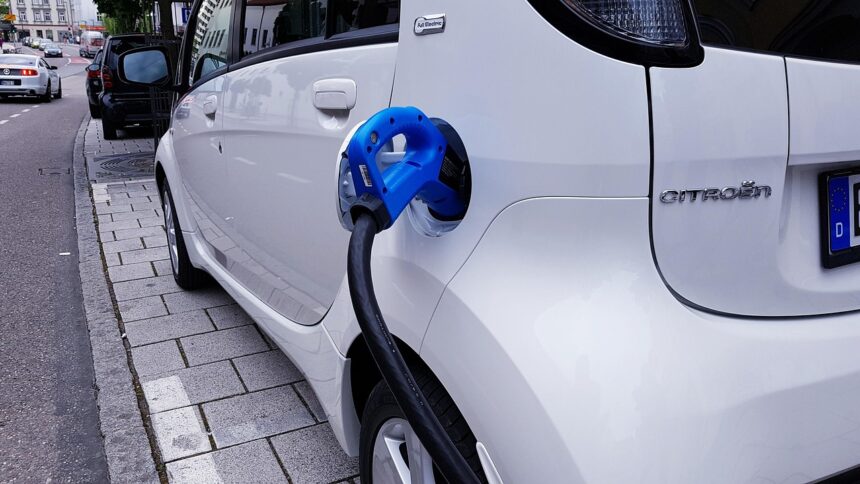
The charging cable is heavier than most people expect. For a 400 V fast charger, that’s partly physics — delivering high power at lower voltage demands high current, and high current demands thick copper. Some estimates put a full EV wiring harness at 132 to 154 lbs (60 to 70 kg), with the chunkiest cables concentrated precisely where drivers grab them every time they plug in.
That cable weight is one of the least-discussed consequences of the voltage standard that dominated electric vehicles for more than a decade. The principle is straightforward: power equals voltage multiplied by current. Double the voltage, and the same power delivery requires half the current. Half the current means thinner wire, smaller busbars, lighter harnesses, and less cooling hardware built around every connector in the vehicle.
The shift to 800 V architecture — popularized by the Porsche Taycan and Hyundai Ioniq 5, which both touted charging sessions as short as 18 minutes — does not simply speed things up. According to the report, it reshapes cable thickness, thermal management, semiconductor selection, and infrastructure compatibility all at once.
What the infrastructure actually supports
Early DC fast chargers were built around battery packs operating at roughly 350 to 500 V, because nearly every EV on the road used a 400 V architecture. That baseline has shifted. Networks like IONNA and Electrify America now deliver up to 350 kW, with hardware supporting output voltages between 920 and 1,000 V — a ceiling that matters because it allows 800 V vehicles to draw large amounts of power without requiring extreme current levels.
The numbers make the problem with lower-voltage charging concrete. Delivering 350 kW to a 400 V vehicle would require approximately 900 amps — well beyond what most charging cables and connectors can handle. At 800 V, the same power draw requires roughly half that current.
But owning an 800 V vehicle does not guarantee 800 V charging. When an 800 V car meets a lower-voltage station, the vehicle must either boost the voltage internally or split its battery pack into two 400 V halves to charge correctly. Battery temperature, station current limits, and the shape of the charging curve all constrain real-world speed regardless of the architecture underneath.

The cost that travels from factory to buyer
The higher-voltage system carries a cost premium that begins in manufacturing and ends with the buyer. Components including silicon carbide (SiC) semiconductors, higher-rated contactors, DC converters, elevated-voltage cooling systems, and reinforced insulation all cost more than their 400 V equivalents. Battery pack segmentation grows more complex. High-voltage safety requirements add further engineering overhead, according to Leapenergy.
Those additional costs accumulate at every stage of production before a vehicle reaches a showroom. The efficiency and weight gains that 800 V architecture delivers are real — lighter cables at charging stations, thinner harnesses inside the car, reduced resistive heat losses across the entire system. The tradeoff is a bill that the supply chain passes forward.
Photo by Pixabay
This article is a curated summary based on third-party sources. Source: Read the original article