The cost and labor bottleneck of physical AI training has long favored a handful of well-resourced labs — Google DeepMind‘s RT-1 required 130,000 episodes gathered over 17 months by human operators, while the DROID project accumulated 76,000 teleoperated trajectories across 13 institutions. Ai2 is now proposing a structurally different approach.
The Allen Institute for AI has released MolmoBot, an open robotic manipulation model suite trained entirely on synthetic data. According to the announcement, the team built a procedural trajectory generation system called MolmoSpaces, combining the MuJoCo physics engine with aggressive domain randomization across objects, viewpoints, lighting, and dynamics. The resulting dataset, MolmoBot-Data, contains 1.8 million expert manipulation trajectories — produced without a single hour of human teleoperation.
“Most approaches try to close the sim-to-real gap by adding more real-world data,” said Ranjay Krishna, Director of the PRIOR team at Ai2. “We took the opposite bet: that the gap shrinks when you dramatically expand the diversity of simulated environments, objects, and camera conditions.”
Pipeline Economics and Architecture
The throughput numbers illustrate why the economics matter. Running on 100 Nvidia A100 GPUs, the pipeline generated approximately 1,024 episodes per GPU-hour — translating to over 130 hours of robot experience for every hour of wall-clock time. The team reports this as nearly four times the data throughput of real-world collection methods.
MolmoBot encompasses three policy classes tested on two hardware platforms: the Rainbow Robotics RB-Y1 mobile manipulator and the Franka FR3 tabletop arm. The primary model uses a Molmo2 vision-language backbone to process multiple timesteps of RGB observations alongside language instructions. MolmoBot-SPOC offers a lightweight transformer variant for edge deployments with constrained compute. MolmoBot-Pi0 adopts a PaliGemma backbone mirroring Physical Intelligence‘s π0 architecture, enabling direct performance benchmarking.
On tabletop pick-and-place tasks, the primary MolmoBot model achieved a 79.2 percent success rate in zero-shot transfer to real-world conditions — with no fine-tuning on real data. Physical Intelligence‘s π0.5, trained on extensive real-world demonstrations, achieved 39.2 percent on the same evaluation. For mobile manipulation, the policies completed tasks including door approach, grasp, and full-range pulling motions.

Open Release and Research Access
Ai2 is releasing the full stack: training data, generation pipelines, and model architectures. This structure allows organizations to audit, adapt, and deploy without dependence on proprietary data infrastructure or vendor lock-in — a deliberate contrast to how capability concentration has developed in the field.
“Our mission is to build AI that advances science and expands what humanity can discover,” said Ali Farhadi, CEO of Ai2. “Demonstrating transfer from simulation to reality is a meaningful step in that direction.”
The release repositions the core constraint in physical AI development: rather than competing on the scale of manual demonstration collection, progress now depends on the quality and diversity of virtual world design — a problem accessible to a much broader research community.
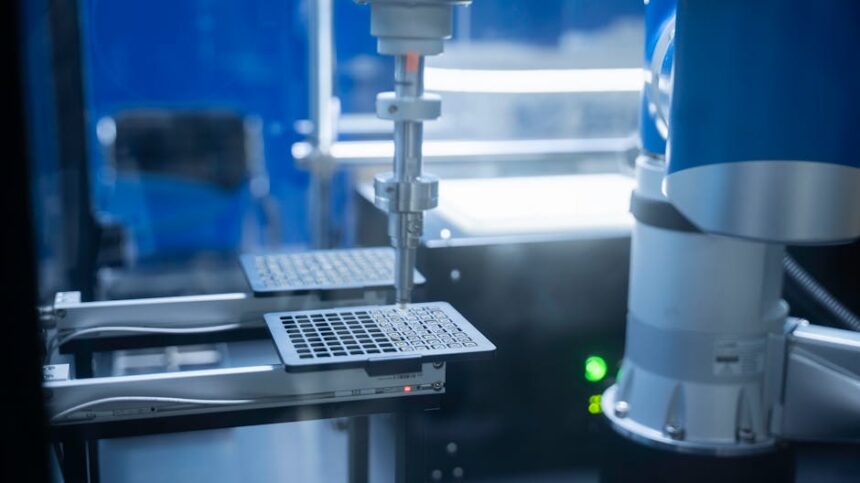
Photo by Youn Seung Jin on Pexels
This article is a curated summary based on third-party sources. Source: Read the original article