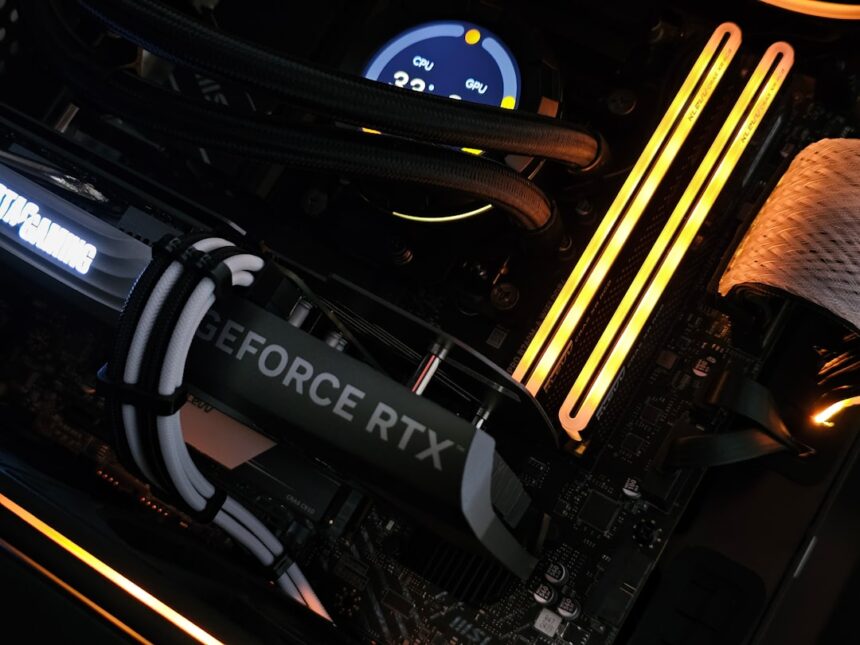
PC gaming has long carried a friction cost that console gaming largely avoids: the first-launch ritual of watching a progress bar crawl through shader compilation, sometimes for several minutes, before a game becomes playable. Microsoft is now moving to eliminate that gap.
At the Game Developers Conference this week, the company provided an update on its Advanced Shader Delivery initiative for Windows, a system designed to distribute precompiled shaders alongside game downloads rather than forcing each player’s machine to compile them locally at runtime. The distinction matters because consoles allow developers to target fixed hardware, making precompilation straightforward. On PC, the sprawling combination of GPU models, driver versions, and vendors has historically made that approach impractical — so developers have defaulted to runtime compilation instead.
How the Pipeline Works
The technical architecture centers on two database layers. Developers use Microsoft‘s Direct3D API to build a State Object Database (SODB), which captures in-game assets at the engine level. That SODB is then processed through multiple shader compilers to produce a Precompiled Shader Database (PSDB) covering display adapters across different hardware vendors. The PSDB ships with the game and, according to the announcement, delivers what the company calls “console-like load times across the hardware ecosystem.”
The system also handles driver updates automatically. When a hardware vendor registers a new driver, a corresponding precompiled shader update can be pushed as a patch, avoiding a full local recompilation on the player’s side.
Microsoft first included Advanced Shader Delivery in its SDK last September and used the ROG Xbox Ally as an early proof of concept by October. The company says the feature reduced launch times in games like Avowed by “as much as 85 percent” — a figure with particular weight on battery-constrained handheld devices.
Ecosystem Adoption Is Still Early
Broad adoption requires buy-in from GPU makers and engine developers, and the current state of commitments is uneven. Nvidia says it is “working closely with Microsoft” to bring Advanced Shader Delivery support to its GeForce RTX line “later this year.” Intel says it is “looking forward to releasing a driver supporting ASD in the near future.” Qualcomm has said it plans to “debut this feature soon on Qualcomm Adreno X2 GPUs.”

Epic Games, whose Unreal Engine underpins a significant share of PC titles, described its position as “doing early testing and explorations on SODB and PSDB generation” with more details “coming soon” — a measured response that stops short of a firm integration commitment.
On the platform side, Microsoft has updated its APIs to simplify PSDB creation and large-game shader compilation. The company is pressing developers to integrate SODB collection into their engines now, ahead of an Xbox Partner Center upload window opening in May. At that point, PC games distributed through the Xbox app will be able to skip local shader compilation at launch.
The company has also signaled that it does not intend to keep the feature exclusive to its own storefront. According to the announcement, “in the future, any storefront can compile the SODBs to… PSDBs and distribute them,” which would extend the benefit across the broader PC gaming distribution landscape if third-party platforms choose to participate.
This article is a curated summary based on third-party sources. Source: Read the original article