Manufacturers deploying intelligent robotics have long faced a stubborn problem: systems that perform well in controlled testing frequently fail on actual production floors, where real-world conditions bear little resemblance to their digital training environments. Against that backdrop, ABB Robotics and NVIDIA have announced a partnership centered on closing what the industry calls the “sim-to-real” gap.
The collaboration produces RobotStudio HyperReality, a platform built by embedding NVIDIA Omniverse libraries directly into ABB‘s existing RobotStudio software. According to the announcement, the product is slated for release in the second half of 2026.
How the System Works
The workflow starts before any hardware is installed. Engineers design, test, and validate complete automation cells digitally — exporting a fully parameterised station, including robots, sensors, lighting, kinematics, and parts, as a USD file into the Omniverse environment. Inside that space, a virtual controller runs the identical firmware found on the physical machine, producing what the companies describe as a 99 percent behavioural match between the simulated and physical environments.
Computer vision models train on synthetic images generated within the software rather than through manual programming. When combined with Absolute Accuracy technology, this approach reduces positioning errors from a range of 8–15 mm down to approximately 0.5 mm. The efficiency gains are significant on paper: the announcement states deployment costs can fall by up to 40 percent and time to market can accelerate by as much as 50 percent.
Marc Segura, President of ABB Robotics, said the integration has “closed technology’s long-standing ‘sim-to-real’ gap — a huge milestone to deploying physical AI with industrial-grade precision, for real-world customer applications.”
Early Adopters Already Testing
Foxconn is using the software for consumer device assembly, an area complicated by frequent product changes and delicate metal components. By training systems on synthetic data, the company anticipates a reduction in setup time and the elimination of costly physical testing cycles.

Workr, a California-based automation provider, integrates its WorkrCore platform with ABB hardware trained via Omniverse. At the NVIDIA GTC 2026 event in San Jose, the firm plans to demonstrate systems capable of onboarding new parts in minutes without requiring specialised programming skills.
Deepu Talla, VP of Robotics and Edge AI at NVIDIA, stated that “integrating NVIDIA Omniverse libraries into RobotStudio brings advanced simulation and accelerated computing to ABB’s virtual controller technology, accelerating how thousands of manufacturers bring complex products to market.”
The hardware scope extends beyond the factory cell itself. ABB is evaluating the integration of NVIDIA‘s Jetson edge platform into its Omnicore controllers, a move the announcement says would enable real-time inference across existing robotic fleets. Digital-first simulation of this kind, according to the report, can reduce setup and commissioning times by up to 80 percent.
The stated next step is the commercial release of RobotStudio HyperReality, scheduled for the second half of 2026.
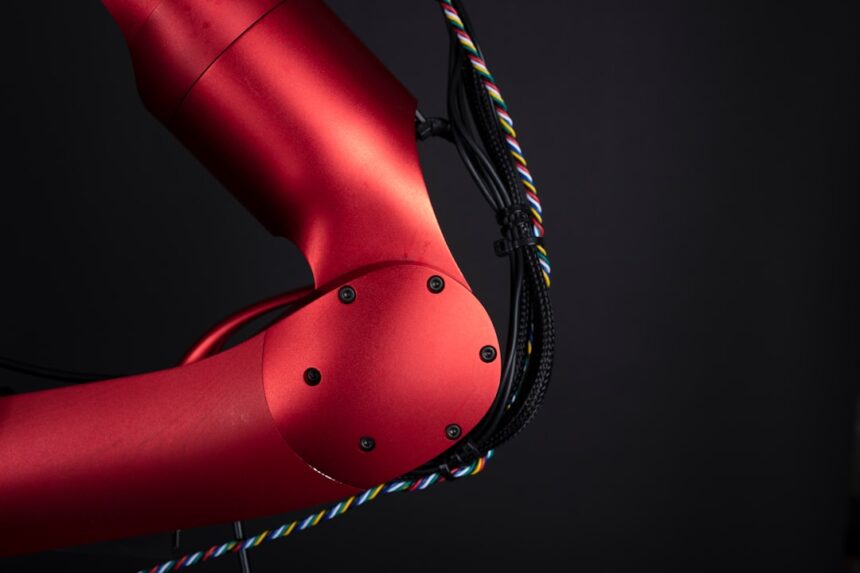
Photo by Mathew Schwartz on Unsplash
This article is a curated summary based on third-party sources. Source: Read the original article