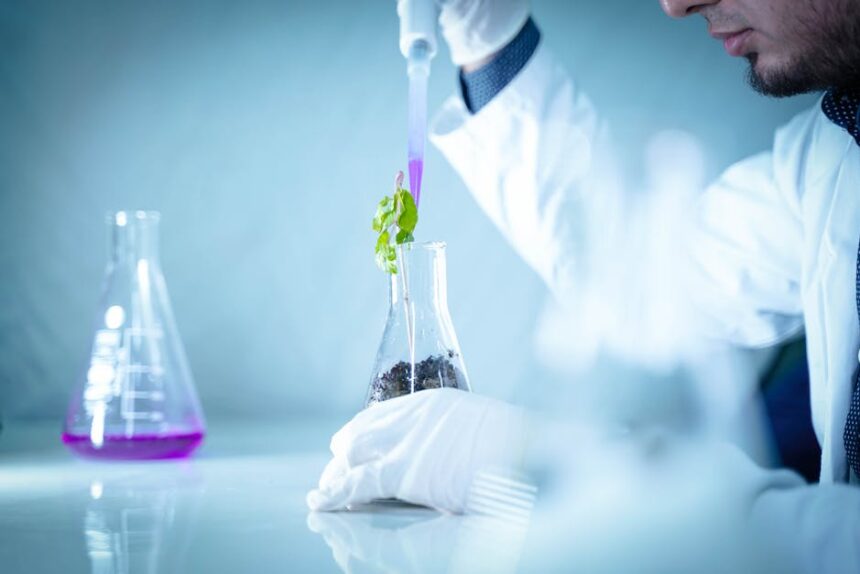
Long-duration space missions have always run into the same wall: food must be carried from Earth, which limits how far and how long humans can travel. Research now suggests lunar agriculture may not be a distant prospect.
Scientists at The University of Texas at Austin, working with collaborators from Texas A&M University, have successfully grown and harvested chickpeas in simulated lunar soil — the first time the crop has been produced in a material designed to mimic the Moon’s surface. The findings were published in the journal Scientific Reports.
The core problem with lunar regolith is structural: it contains no organic matter or microorganisms, and while it does carry minerals plants can use, it also holds heavy metals that interfere with plant development. The research team addressed both deficiencies simultaneously. They mixed simulated lunar soil produced by Exolith Labs — formulated to match the composition of Apollo-era samples — with vermicompost generated by red wiggler earthworms digesting organic waste. Before planting, seeds were coated with arbuscular mycorrhizae fungi, which form a symbiotic relationship with plant roots, improving nutrient absorption while limiting heavy metal uptake.
What the Experiment Showed
Plants grew successfully in mixtures containing up to 75% simulated lunar soil. Beyond that threshold, stress responses increased and plants died sooner. Fungi-inoculated plants consistently outlasted non-inoculated ones under identical conditions, and the fungi established themselves within the simulated regolith — suggesting, according to the announcement, that a single introduction might suffice in a real lunar farming system.
Sara Santos, the project’s principal investigator and a distinguished postdoctoral fellow at the University of Texas Institute for Geophysics, framed the work around a conversion question: “How do we transform this regolith into soil? What kinds of natural mechanisms can cause this conversion?”
The vermicompost component carries a practical logic for space missions. Red wiggler worms could process discarded materials — food scraps, cotton clothing, hygiene products — that would otherwise constitute waste, closing a resource loop aboard a lunar outpost.

What Remains Unresolved
The harvest milestone leaves two consequential questions open. Researchers have not yet confirmed whether the chickpeas absorb harmful metals from the regolith at levels that would make them unsafe, and nutritional adequacy for astronauts has not been verified. “We want to understand their feasibility as a food source,” said first author Jessica Atkin.
The timing is not incidental. As NASA moves forward with the Artemis II mission and broader lunar exploration objectives, the logistics of feeding crews on the surface become an operational concern rather than a theoretical one. Chickpeas carry specific advantages in that context: they fix atmospheric nitrogen, which could help condition soil over successive growing cycles, and they are a dense source of protein and calories.
The study does not claim readiness for deployment. It establishes that the biological mechanisms — fungal symbiosis, microbial soil enrichment, seed germination — can function in a regolith-dominant medium, which is the necessary prior condition for any more applied development.
Photo by Mehul Patel on Pexels
This article is a curated summary based on third-party sources. Source: Read the original article