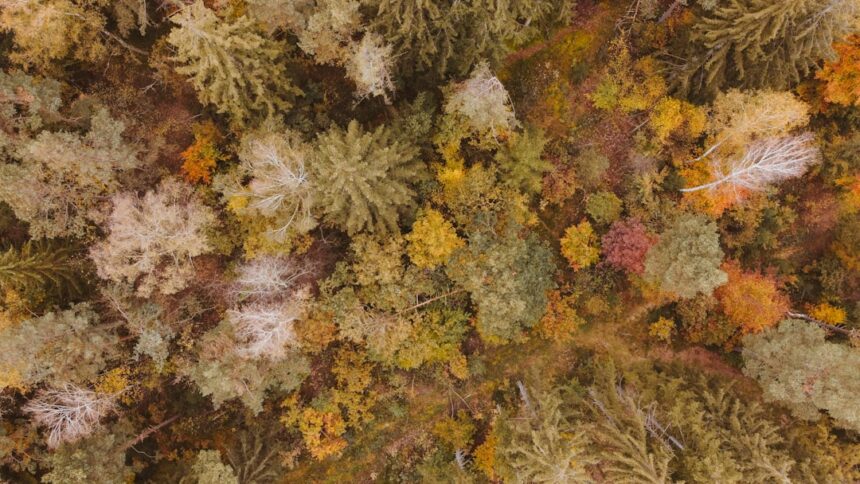
A sunken landmass between Britain and mainland Europe supported temperate forests thousands of years before those same forests recolonized northwestern Europe, ancient DNA evidence suggests.
Parts of Doggerland — now submerged beneath the North Sea — hosted oak, elm, and hazel trees as early as 16,000 years ago. That predates the forests that spread across Britain and northwestern Europe after glaciers fully retreated around 11,700 years ago.
The prevailing assumption had placed southern Doggerland in tundra at that point in time. Ice sheets at that period extended as far south as the current Scotland-England border.
What the DNA revealed
Researchers drilled 41 sediment cores — yielding 252 samples — from beneath the North Sea off the English coast. The cores followed the path of a prehistoric waterway known as the Southern River, a 20-mile-long (30-kilometer) channel that once ran through southern Doggerland.
The team extracted ancient sedimentary DNA preserved in the seafloor sediments and used it to reconstruct a long-lost terrestrial ecosystem.
“We got evidence of boars, deer, bears, aurochs,” said Robin Allaby, evolutionary geneticist and professor of genomics at the University of Warwick. According to the announcement, Allaby described it as “the largest sedimentary DNA study that’s been done.”
The researchers sorted sediments into two categories: secure and insecure. Fine silts and clays held DNA from species that actually lived near each core site. Coarser sands and gravels carried DNA transported from elsewhere by fast-moving water, making it unreliable for reconstructing local conditions.
The logic, Allaby noted, is straightforward — “DNA doesn’t survive long in water.” Slow-moving water deposits fine sediments and can only carry DNA short distances before it degrades. Fast-moving water shifts coarser material over greater distances, preserving DNA that originated far from where it was eventually deposited.
Timeline revised
Doggerland is named after Dogger Bank, a large North Sea sandbank, which itself takes its name from a type of medieval Dutch fishing vessel.
Previous estimates placed the full inundation of Doggerland at around 7,000 years ago. The new findings suggest the landmass may have survived until closer to 6,000 years ago.
The region, which once connected Britain to continental Europe, had long been known to be forested before it disappeared beneath the sea. The age of those forests, however, was unresolved — scientists had assumed they formed on roughly the same timeline as forests in Britain.
The new evidence places a functioning, species-rich woodland ecosystem in southern Doggerland at a time when the region was thought to be barren tundra, suggesting it may have served as a refuge for both wildlife and humans during the final phase of the last ice age.
Photo by Shutter Speed on Unsplash
This article is a curated summary based on third-party sources. Source: Read the original article