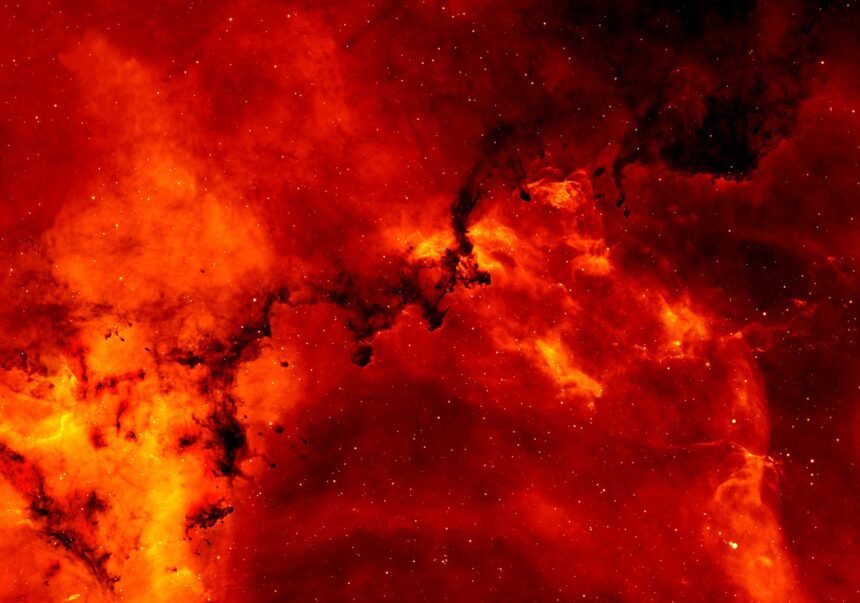
The James Webb Space Telescope has captured new images of Nebula PMR 1, a rarely studied cloud of gas and dust surrounding a dying star. Researchers have nicknamed it the “Exposed Cranium” nebula because it looks like a brain floating inside a transparent skull.
A dark lane runs vertically through the center of the nebula, splitting it into two lobes that mirror the left and right hemispheres of a human brain.
Webb observed the object using two instruments: NIRCam (Near-Infrared Camera) and MIRI (Mid-Infrared Instrument). Both captured the dark dividing lane, along with layered structures that were not visible in earlier observations. The nebula was first detected in infrared light more than a decade ago by NASA‘s now-retired Spitzer Space Telescope, but according to the announcement, Webb’s instruments produce a sharper and far more detailed view.
The dark central lane may be connected to twin jets shooting material outward from the star in opposite directions — a process that would explain the structure’s distinctive split shape. Evidence of this activity appears most clearly near the top of the nebula in the MIRI image, where gas from the inner region looks pushed outward.
Layers Tell the Star’s History
The nebula’s outer shell is made mostly of hydrogen expelled in an earlier phase of the star’s evolution. The inner region is more complex, containing a mix of gases and finer structural detail. Together, these layers reflect successive rounds of material shedding as the star burned through its fuel.
Webb has caught this process mid-act.

The star is in a late phase of its life, shedding its outer layers into surrounding space. What happens next depends on the star’s mass, which scientists have not yet determined. A sufficiently massive star could end in a supernova explosion. A lower-mass star — one closer to the Sun in size — would continue losing material until only a dense white dwarf core remains, cooling gradually over an enormous span of time.
What Webb Is Built to Do
Webb is an international collaboration led by NASA in partnership with the European Space Agency and the Canadian Space Agency. It is designed to study objects across a wide range — from bodies within the solar system to the structure of galaxies across cosmic history. The “Exposed Cranium” nebula sits within that broader mission: a brief, dramatic phase in stellar evolution that Webb’s infrared capabilities are uniquely equipped to document in detail not previously achievable.
Photo by Pixabay
This article is a curated summary based on third-party sources. Source: Read the original article