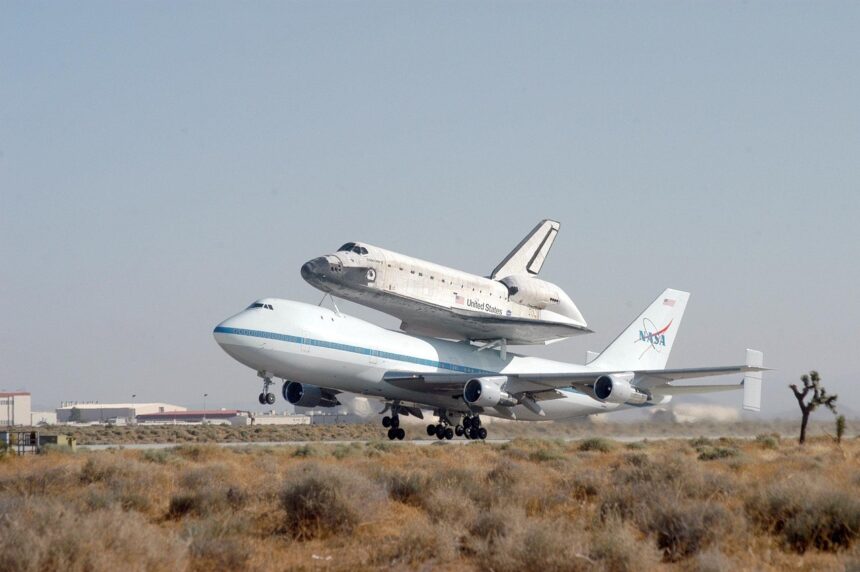
NASA released a draft request for proposal on March 19 seeking contractor input on transporting large spacecraft and smaller capsules — a move required by federal law.
The One Big Beautiful Bill Act mandates that NASA relocate a human-rated spacecraft to a nonprofit display facility near an agency center connected to the commercial crew program. Texas senators wrote the legislation with Space Center Houston in mind, but Senate rules forced the language to stay vague.
The draft RFP frames two scenarios as “illustrative examples.” The first covers relocating a large vehicle comparable to a space shuttle orbiter or solid rocket booster. The second covers transporting a smaller capsule comparable to an Orion crew module or Mercury capsule. According to the draft, the examples “represent the range of transportation scenarios that NASA may need to support under this contract vehicle.”
Neither scenario is identified as preferred. The document does not indicate which artifact will move, where it will go, or when.
Sen. John Cornyn issued a statement Friday saying his “law authorizing and funding the space shuttle Discovery‘s movement to Houston is being set into motion,” and credited NASA Administrator Jared Isaacman for keeping the process moving.
Isaacman, however, has left the door open to sending something other than Discovery. In a December 2025 interview with CNBC, he said his priority is ensuring any transport of the shuttle can be done safely and within available budget. “If we can’t do that, you know what? We’ve got spacecraft that are going around the moon with Artemis II, III, IV, and V,” he said.

Contractors responding to the draft must submit replies of no more than 40 pages covering engineering analyses, transportation planning, preservation measures, specialized rigging systems, infrastructure coordination, regulatory compliance, and multimodal transportation execution. The agency is also requesting cost estimates — not binding price proposals — for completing each move within a five-year window.
Transportation modes can be chosen by the respondent. The draft lists airlift, sealift, rail transport, overland heavy haul, and barge transport as possibilities.
The winning contractor will bear full responsibility for providing rigging equipment. NASA is not supplying any of its own infrastructure — and in the case of Discovery, the specialized sling historically used to hoist shuttle orbiters no longer exists. It was scrapped after the California Science Center raised Endeavour to a vertical display position in 2024. The contractor must also provide artifact preservation and curatorial support to protect the spacecraft throughout transit.
Photo by Pixabay
This article is a curated summary based on third-party sources. Source: Read the original article