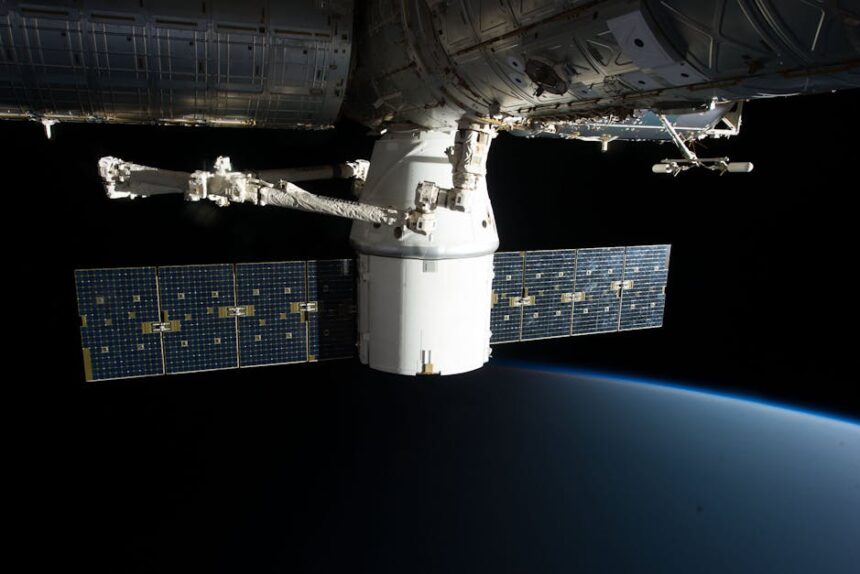
Solar array upgrades at the International Space Station have been underway since 2021, with six rollout panels already deployed. The seventh moved a step closer on Wednesday.
NASA astronauts Jessica Meir and Chris Williams exited the station’s Quest airlock at 8:52 a.m. EDT on March 18, 2026, marking the first U.S. spacewalk in almost a year. The two Expedition 74 crewmates spent just over seven hours outside, with their primary task being the assembly and attachment of a mounting bracket on the port side of the station’s backbone truss. That bracket will hold a new ISS Roll-Out Array (iROSA), to be installed during a separate, future spacewalk.
Once deployed, it will be the seventh of eight planned rollout arrays.
The iROSAs differ from the station’s original four solar wings in both size and design. Smaller than the legacy panels, they require no motor to unfurl. According to the announcement, potential energy stored in rolled-up carbon composite booms is sufficient to extend each array to its full 63-foot (19-meter) length in approximately six minutes. The original arrays have exceeded their 15-year service life and have degraded over time. When all eight iROSAs are in place, they are expected to increase the station’s electricity supply by 20% to 30%.
That additional power is intended to support expanded commercial activities and the transition from the ISS to commercially operated space stations. The rollout array technology has also been used beyond low Earth orbit — NASA applied it to the Double Asteroid Redirection Test (DART) mission in 2022, which successfully altered the orbit of a small asteroid. The agency had also planned to use the technology on its Gateway moon-orbiting station, though the report notes that outpost may be canceled.
About five hours into the extravehicular activity, the crew split tasks. Williams moved to photo-document the gears of the port-side Solar Array Rotating Joint — the mechanism that allows the wings to track the sun. Meir worked simultaneously on installing an electrical jumper to enable robotic servicing of components in the 2A power channel.

The spacewalk had been planned to last approximately 6.5 hours but ran to 7 hours and 2 minutes, ending at 3:54 p.m. EDT. With time running short, EVA managers deferred two lower-priority tasks — exterior microorganism swabbing and installation of a lens cover on the Canadarm2 robotic arm — to a future outing. Neither was considered mission critical.
“Well done!” Meir told Williams just before he reentered the hatch. “It was a lot of work and a lot of fun,” he replied.
The iROSA modification kit installation had originally been scheduled for a spacewalk in May 2025 before being postponed. The actual iROSA panel will be installed on a future spacewalk.
This article is a curated summary based on third-party sources. Source: Read the original article