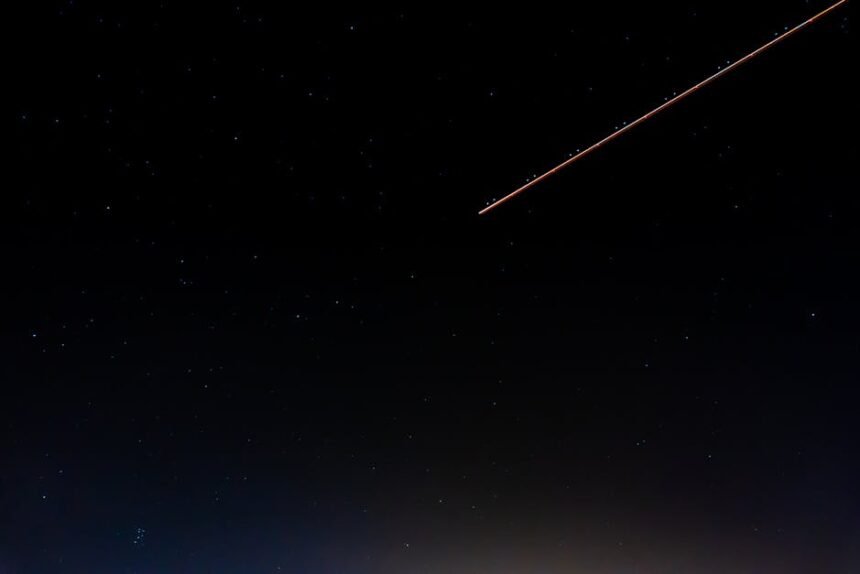
A fireball tore across the Midwest sky on the morning of March 17, striking Earth’s atmosphere at 8:57 a.m. EDT. The event generated over 200 fireball reports on the American Meteor Society website.
The meteoroid weighed approximately 7 tons (7,000 kilograms) and fractured on entry with the force of 250 tons of TNT, sending pressure waves through the air and triggering sonic booms heard across much of northern Ohio. According to NASA, fragments scattered in the vicinity of Medina County.
Daytime fireballs are rare. They occur when large fragments of asteroids or comets collide with Earth’s atmosphere, compressing air molecules and leaving a fiery trail.
The American Meteor Society‘s computer-generated map, built from eyewitness reports, places the fireball’s final trajectory between Akron and Canton, Ohio. But AMS fireball report coordinator Robert Lunsford cautions against treating that data as precise. “This area may be off by many miles in any direction,” he told the source, noting that many eyewitnesses submitted reports with incorrect dates — some listed February, others simply the year 2025.
What the Fragments Look Like
The original meteoroid measured roughly 6 feet (1.8 meters) in diameter before entering the atmosphere. Any surviving ground fragments are expected to be far smaller — just 1 to 2 inches (2.5 to 5 centimeters) across.
According to Lunsford, the pieces would stand out from ordinary local rocks. “They usually have a fusion crust, created by the intense heat while passing through the atmosphere,” he said. “They would probably look like bits of charcoal on the outside and lighter on the inside if broken.”

At least one Medina County family says they already found one — a walnut-sized rock in their driveway. Resident December Harris described it in an interview with Fox 8 News: “It’s definitely black like a black coal. You can see some areas that’s been melted as it came through.”
Safe to Handle
Anyone who finds a suspected fragment does not need to worry about heat. Despite the violence of atmospheric entry, the rocks cool well before impact.
Lunsford explains why: fragments reach terminal velocity of around 300 mph while still miles above the ground. The final stage of their descent is essentially a cold free-fall, with no further friction generating heat. By the time a meteorite lands, it is safe to pick up — though handling it with care preserves its scientific value. Oils from human skin can contaminate the sample and compromise laboratory analysis, so researchers generally recommend using gloves or a clean cloth and storing the fragment in a sealed plastic bag away from moisture.
Meteorites carry both scientific and monetary value, preserving chemical records from the early solar system billions of years old.
Photo by Achraf Alan on Pexels
This article is a curated summary based on third-party sources. Source: Read the original article