Seventeen years. That is how long it had been since the American College of Sports Medicine last issued a formal Position Stand on resistance training for healthy adults — a gap that, according to the announcement, allowed an entire wave of muscle health research to accumulate without being reflected in official guidance.
The updated recommendations, now published in Medicine & Science in Sports & Exercise, are built on 137 systematic reviews covering more than 30,000 participants, making it the most extensively evidenced set of resistance training guidelines produced to date.
The central finding is disarmingly plain.
Stuart Phillips, a distinguished professor in the Department of Kinesiology at McMaster University and an author on the Position Stand, put it directly: “The best resistance training program is the one you’ll actually stick with.” Training all major muscle groups at least twice a week, he says, matters far more than pursuing a complex or theoretically optimal plan. “Whether it’s barbells, bands, or bodyweight, consistency and effort drive results.”
That framing cuts against a fitness culture that has spent decades layering complexity onto what the evidence, according to Phillips, simply does not support. Strict rules about ideal load, volume, and frequency are no longer backed by current research. Personal preference, enjoyment, and long-term maintainability now carry more weight in the updated guidance than any particular combination of sets and reps.
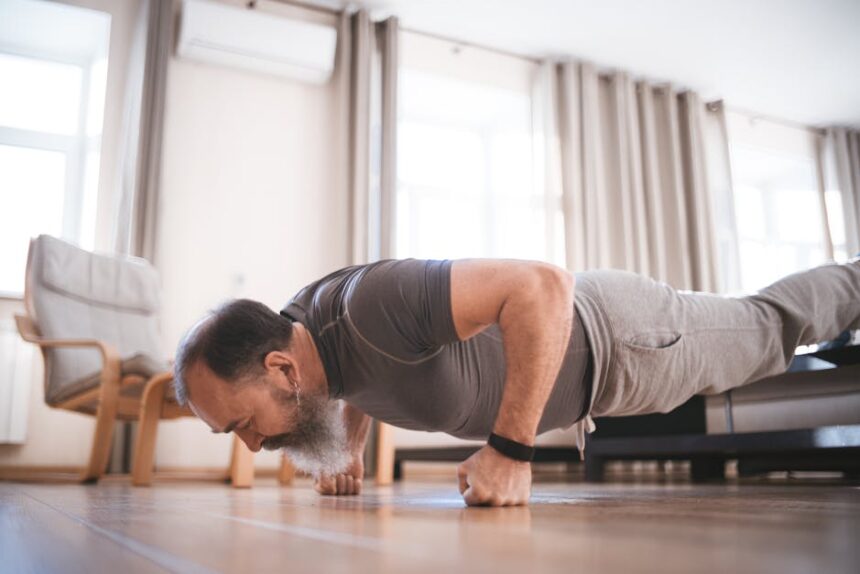
One of the more significant shifts in the new Position Stand is its explicit recognition that a gym is not required. Elastic bands, bodyweight movements, and at-home routines can produce measurable gains in muscle size, strength, and daily physical function. For the large share of adults who cite access or convenience as barriers, the guidance removes the premise that those barriers are disqualifying.

The updated document also broadens who the recommendations speak to. The 2009 version was released before research into strength’s relationship with aging, long-term health, and physical function reached its current scale. Phillips notes that the new guidelines “expand its recommendations to include more people and more types of training than ever before” — a direct response to that surge in evidence.
For most adults, the practical implication is that the largest gains tend to come from the earliest transition: moving from no resistance training at all to any regular activity. Beyond that threshold, refinements in programming have diminishing returns for the general population. Athletes and highly trained individuals retain a separate calculus — sport-specific demands may still require more structured periodization — but the guidance is not written for them.
It is written for everyone else, and its instruction is to start, keep going, and not wait for the perfect plan.
Photo by Mikhail Nilov on Pexels
This article is a curated summary based on third-party sources. Source: Read the original article