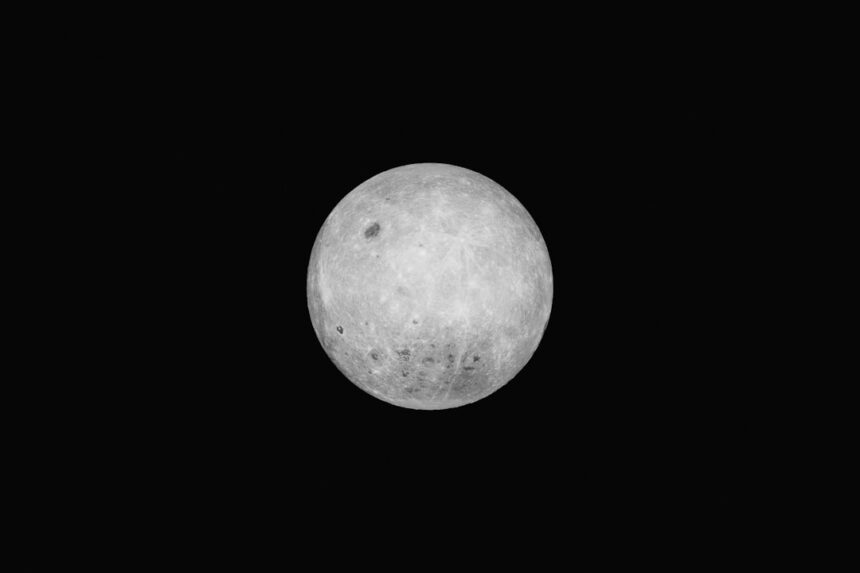
For decades, scientists could not agree on whether the early moon once produced a powerful magnetic field or a weak one. A new study from the University of Oxford suggests the answer is both, depending on when you look.
Today the moon has no magnetic field at all. But rock samples returned by NASA’s Apollo missions carry strong magnetic signatures, which had long led researchers to conclude the young moon once hosted a vigorous internal dynamo comparable to Earth’s. Smaller groups of scientists pushed back, arguing the moon’s relatively modest size made sustaining such a field for hundreds of millions of years physically implausible.
A Bias Built Into the Samples
The Oxford team’s resolution centers on a sampling problem that had quietly distorted the field’s understanding for half a century. All six Apollo missions landed in flat, dark volcanic plains called mare regions. These areas happen to be unusually rich in a specific type of volcanic rock that captured strong magnetic events in its crystal structure.
That concentration skewed what scientists thought was a representative record of lunar history. “Our new study suggests that the Apollo samples are biased to extremely rare events that lasted a few thousand years, but up to now, these have been interpreted as representing 0.5 billion years of lunar history,” said Claire Nichols, the study’s lead author and an associate professor at Oxford. “It now seems that a sampling bias prevented us from realizing how short and rare these strong magnetism events were.”
Titanium as the Key Signal
Analyzing the chemistry of mare basalts, the researchers found a direct link between titanium content and magnetic field strength. Samples recording strong magnetic fields contained high levels of titanium. Samples recording weak fields did not.
That chemical pattern pointed to a specific mechanism. According to Nichols, melting of titanium-rich rocks at the moon’s core-mantle boundary produced brief but intense bursts of magnetic activity. “For very short periods of time, no more than 5,000 years, but possibly as short as a few decades, melting of titanium-rich rocks at the moon’s core-mantle boundary resulted in the generation of a very strong field,” she said.

Outside those episodes, between roughly 3.5 and 4 billion years ago, the lunar magnetic field was weak. That finding aligns with established dynamo theory for a body of the moon’s size.
What the Models Confirm
Computer simulations supported the conclusion. When researchers modeled what scientists would have found had Apollo missions sampled the lunar surface at random, rather than concentrating in the mare regions, the probability of capturing one of these magnetic spikes dropped sharply. The models reinforced the argument that strong field episodes were rare exceptions embedded in a much quieter baseline.
The broader significance extends beyond resolving an academic dispute. Magnetic fields deflect solar wind, and their presence or absence shapes how a planetary surface weathers over time. Tracing the moon’s magnetic history gives scientists a clearer picture of how its core cooled and why its internal geologic activity gradually wound down. It also provides a reference point for comparing the internal evolution of other rocky bodies in the solar system.
The study’s findings were published with input from reanalyzed Apollo sample data, reinforcing the enduring scientific value of material collected during missions that ended more than 50 years ago.
This article is a curated summary based on third-party sources. Source: Read the original article