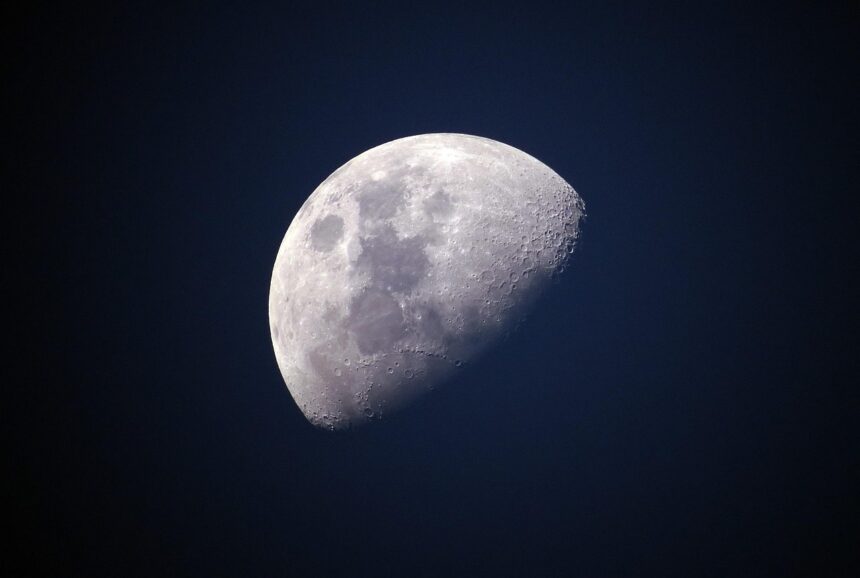
Asteroid 2024 YR4 will not strike the moon in 2032, scientists have confirmed, closing out a months-long period of uncertainty that had briefly made the space rock the most dangerous asteroid ever recorded.
The James Webb Space Telescope resolved the question by observing the asteroid between Feb. 18 and Feb. 26 this year, tracking its movement against a background of stars whose positions had been precisely catalogued by the European Space Agency‘s Gaia mission. The measurements allowed researchers to refine the asteroid’s solar orbit with enough precision to rule out a lunar collision. According to the announcement, 2024 YR4 will instead pass 13,200 miles (21,200 kilometers) above the lunar surface.
The rock, roughly 197 feet (60 meters) in diameter, was discovered on Dec. 27, 2024 by the NASA-funded Asteroid Terrestrial-impact Last Alert System (ATLAS). It initially carried a non-zero probability of hitting Earth on Dec. 22, 2032 — enough to trigger formal monitoring. An object of that size could level a city or, if it hit an ocean, generate tsunamis threatening multiple coastlines.
Earth was eventually ruled out as an impact target, but the moon was not. A 4.3% collision probability remained, driven by incomplete data on the asteroid’s orbital path. Astronomers had expected to wait until 2028 for their next observation window.
A Difficult Measurement
Researchers at the Johns Hopkins University Applied Physics Laboratory (JHUAPL) identified a narrow window when the telescope could observe the asteroid as it crossed a faint, well-mapped star field. The Near-Infrared Camera used for the observation has a field of view of just 2.2 square arcminutes, and the report notes the asteroid ranked among the faintest objects the telescope has ever targeted.
JHUAPL scientists coordinated with the telescope’s engineering team, ESA‘s Near-Earth Object Coordination Centre, and NASA‘s Center for Near-Earth Object Studies to make the precise pointing possible.

What a Strike Would Have Meant
Had the asteroid hit the moon’s near side, the impact would have released energy equivalent to 6 million tons of TNT — comparable to a large nuclear detonation — carving a crater approximately 0.62 miles (1 kilometer) wide. It would have been the first large lunar impact observed at close range.
The spectacle would have been visible from Earth as a bright flash. Most debris would have fallen back onto the lunar surface, but millions of pounds of ejecta would have escaped the moon’s gravity and entered Earth’s vicinity — a hazard to orbiting satellites and, potentially, a source of meteor showers lasting several days. Some material could have lingered in near-Earth orbital space for years.
The close pass in 2032 still stands. At 13,200 miles, it will be a near miss by any measure, but the moon, and everything around it, will remain intact.
Photo by Pixabay
This article is a curated summary based on third-party sources. Source: Read the original article