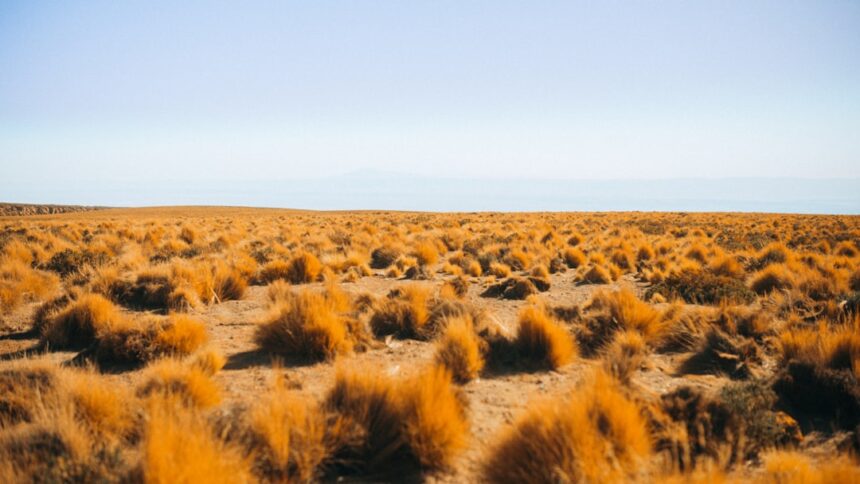
Beneath the surface of Chile’s Atacama Desert, one of the most arid places on Earth, a hidden world of microscopic worms is thriving. New research led by the University of Cologne has found that communities of soil-dwelling nematodes survive across the Atacama in surprising diversity, reshaping what scientists thought possible in extreme environments.
The study, published in Nature Communications, examined six distinct regions of the desert, each with sharply different conditions. Researchers collected soil samples from sand dunes, salt flats, riverbeds, and mountainous terrain, then analyzed biodiversity, reproductive strategies, and population structures among the nematode communities living there.
Why the Atacama Is So Extreme
The Atacama regularly draws comparisons to polar deserts. Almost no rainfall reaches its surface. Salt levels in the soil run high. Temperature swings are severe. UV radiation is intense. These conditions place it among the harshest landscapes on the planet, which is precisely what makes the new findings significant.
The international team, which brought together specialists in zoology, ecology, and botany, worked under the Collaborative Research Centre 1211, a long-term research program studying life at what scientists call the “dry limit.” Their goal was to understand how multicellular organisms, not just microbes, persist where almost nothing should.
What the Data Showed
Biodiversity tracked closely with moisture. Areas receiving more precipitation supported a greater variety of species. Altitude shaped which communities appeared in specific zones, with higher elevations hosting more nematode variety along with more vegetation and humidity.
One of the clearer findings involved reproduction. At higher elevations, many nematode species reproduce asexually, a strategy known as parthenogenesis. This lends support to an idea that had circulated in scientific literature but lacked confirmation in the field: that asexual reproduction may carry survival advantages in environments where resources are scarce and conditions are unpredictable.
The most extreme zones, including highly saline flats exposed to intense UV radiation, still supported nematode life, though with narrower species diversity.
The Role Nematodes Play
Nematodes rank among the most numerous animals in soil ecosystems worldwide. They regulate bacterial populations, drive nutrient cycling, and function as reliable indicators of soil health. Their presence across environments as varied as deep ocean sediments and Arctic soils has made them useful subjects for studying biological resilience.
Dr. Philipp Schiffer of the University of Cologne’s Institute of Zoology, one of the study’s authors, emphasized what this kind of research addresses. “Soils are important for the performance of an ecosystem, for example for carbon storage and nutrient supply. This is why understanding the organisms, i.e. not microbes, but multicellular animals, that live there is so important,” he said. “Data on soils in extreme ecosystems such as the Atacama Desert is still scarce.”
Implications Beyond the Atacama
The findings carry weight beyond Chile. The research suggests that arid regions globally may support more biological diversity than earlier surveys indicated. Deserts that scientists once considered largely lifeless at the soil level may contain structured, functioning ecosystems.
At the same time, the study raises a concern that follows directly from the discovery. Ecosystems that survive in such narrow environmental bands are also highly sensitive to disruption. Even modest shifts in moisture or temperature could alter which species persist and which disappear, with consequences for soil health in regions where that resource is already stretched thin.
Photo by Laércio Milani on Unsplash
This article is a curated summary based on third-party sources. Source: Read the original article