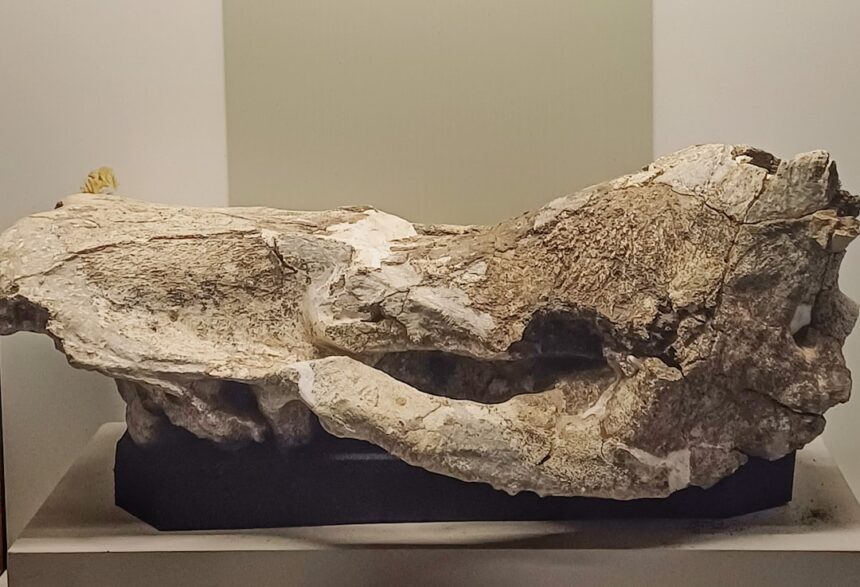
Childbirth was likely painful and risky for Australopithecus — the ape-like hominins that walked African landscapes between roughly 2 million and 4 million years ago — according to a study published in The Anatomical Record.
Researchers simulated labour in three Australopithecus individuals spanning different species: Australopithecus afarensis, Australopithecus africanus, and Australopithecus sediba.
To model pelvic floor muscles, the team took an MRI scan of a pregnant woman, extracted a three-dimensional image of her pelvic floor, and morphed it to fit each ancient pelvis. They then simulated a baby passing through and calculated the forces involved.
Forces Comparable to Modern Human Labour
The pelvic floors of the simulated Australopithecus births experienced forces of 4.9 to 10.7 megapascals. Modern human labour generates 5.3 to 10.5 megapascals on the same structures — a near-identical range.
The birth canal in these early hominins was oval-shaped, wide from left to right but narrow front to back. That geometry differs from chimpanzees, whose canals are oriented the opposite way, and from modern humans, whose canals are more circular.
Pierre Frémondière, a midwife at Aix-Marseille University and one of the study’s authors, says the findings suggest deep evolutionary continuity. “We show that Australopithecines are quite similar to modern humans,” he said. “If they had lots of deliveries, probably they would have a greater risk of pelvic floor disorder.”

In modern women, pelvic floor damage during vaginal birth is common. An estimated 1 in 4 women experience pelvic floor disorders such as incontinence or organ prolapse.
Experts Flag the Limits
Lia Betti at University College London, who was not part of the research team, called the use of multiple pelvises and comparison to live human birth data “a really good way of checking that your model is robust.” She remained cautious overall.
Betti pointed out that the pelvic floor muscles of Australopithecus may have differed structurally from human ones — making them more or less prone to tearing — and that difference cannot currently be measured from fossils.
A separate issue emerged during validation. When the team modelled two modern human births as a check, a baby in one simulation failed to rotate in the birth canal as it would in reality. That suggests the model is missing key biomechanical factors.
The dataset itself is thin. Only three Australopithecus pelvises exist, each from a different species. No pelvises survive from any earlier hominin.
Frémondière acknowledged the constraints directly. “I think that we are just at the beginning of this kind of study,” he said.
Photo by Ibrahim Jonathan on Unsplash
This article is a curated summary based on third-party sources. Source: Read the original article