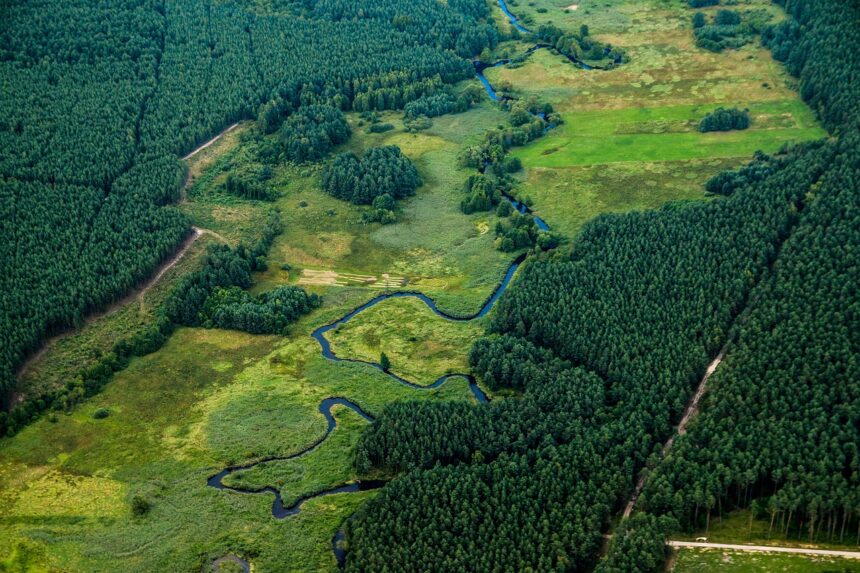
A beaver-engineered wetland in Switzerland stored 1,194 tonnes of carbon over 13 years, up to ten times more than comparable areas without beavers, according to a new study led by researchers at the University of Birmingham.
Published in Communications Earth & Environment, the research is the first to measure both carbon dioxide released and captured as a direct result of beaver activity. The study involved collaborators from Wageningen University, the University of Bern, and several international institutions, all working from a stream corridor in northern Switzerland where beavers have been active for more than a decade.
The wetland stored an average of 98.3 ± 33.4 tonnes of carbon per year, equivalent to 10.1 tonnes of CO₂ per hectare annually. That output was driven largely by the removal and retention of dissolved inorganic carbon beneath the surface — a process set in motion by the animals’ dam-building, which slows water flow, floods adjacent land, and traps sediment, organic matter, and deadwood.
How Beaver Dams Reshape Carbon Storage
“Our findings show that beavers don’t just change landscapes: they fundamentally shift how CO₂ moves through them,” said Dr. Joshua Larsen, lead senior author and researcher at the University of Birmingham. “By slowing water, trapping sediments, and expanding wetlands, they turn streams into powerful carbon sinks.”
Researchers built their conclusions from a combination of hydrological measurements, chemical testing, sediment analysis, greenhouse gas monitoring, and long-term modeling — producing what the announcement describes as the most complete carbon budget yet assembled for a beaver-influenced landscape in Europe.
Seasonal variation complicated the picture. During summer months, falling water levels exposed more sediment, briefly tipping the system into a net carbon source as CO₂ emissions temporarily exceeded storage. Over a full annual cycle, however, accumulated plant matter, sediment, and deadwood reversed that balance decisively.
More Read

Methane emissions, which can offset carbon gains in wetland environments, were negligible — accounting for less than 0.1% of the total carbon budget.
Implications for European Conservation
Beavers have been returning to rivers across Europe following sustained conservation efforts, and the study suggests that recovery carries measurable climate value, particularly in headwater streams where rivers originate and where beaver activity most directly reshapes hydrology.
Dr. Lukas Hallberg, corresponding author from the University of Birmingham, noted that the Swiss site had already become a long-term carbon sink within just over a decade — well ahead of what researchers would project for an unmanaged wetland of similar size.
The findings support the case for factoring beaver reintroduction into nature-based climate strategies, though the study stops short of prescribing specific policy targets or quantifying how much carbon European beaver populations could collectively store at scale.
Photo by Pixabay
This article is a curated summary based on third-party sources. Source: Read the original article