Galaxy season arrives each spring, when the night sky tilts away from the Milky Way’s crowded stellar disk and opens toward a vast concentration of galaxies behind the constellations of Leo, Virgo, Coma Berenices, Canes Venatici, and Ursa Major.
A basic telescope aimed at least 30 degrees above the horizon is enough to get started. Smart telescopes that stack and send live images to a smartphone work well for fainter targets.
The Top Targets
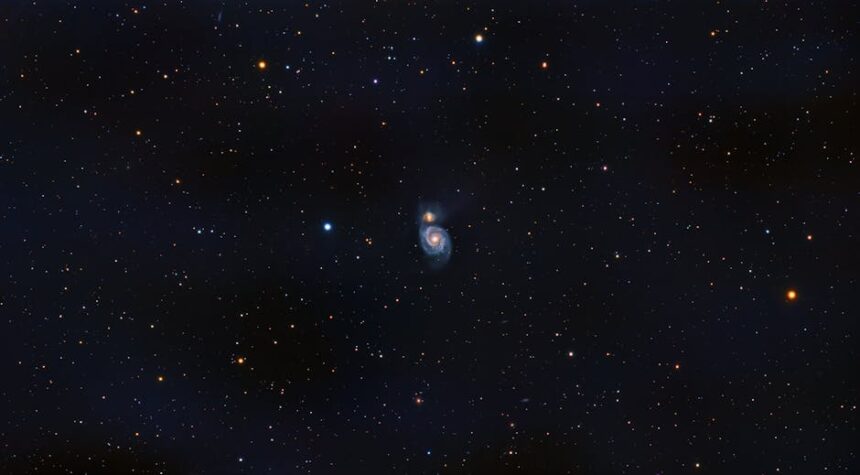
M51, the Whirlpool Galaxy, sits 31 million light-years away in Canes Venatici at magnitude 8.4. It was the first galaxy ever classified as a spiral, and its face-on orientation makes that structure immediately visible. With enough imaging time, a small companion galaxy, NGC 5195, appears at the tip of one spiral arm. According to the report, a smart telescope like the ZWO Seestar S50 pulls it up on a smartphone within seconds.
In Ursa Major, Bode’s Galaxy (M81, magnitude 6.94) and the Cigar Galaxy (M82, magnitude 8.41) sit close enough together to fit in the same frame. M81 is a spiral; M82 is a starburst galaxy. Both are accessible to beginners — a 660 mm focal length refractor such as the Celestron Inspire 100AZ shows them under dark skies.
M101, the Pinwheel Galaxy, is large but has low surface brightness, meaning its sprawling arms disappear quickly under light pollution. Dark skies are not optional here. The Vaonis Vespera II handles automated stacking in compromised conditions, while the Celestron Advanced VX 8 Edge HD paired with a dedicated astro-camera can extract faint structural detail through longer exposures.
The Leo Triplet — M65, M66, and NGC 3628 — sits below the belly of Leo and offers three galaxies within a single field of view. Few spring targets match that return. It consistently ranks among the first objects observers return to when pulling a telescope out of winter storage.

What You Need
Aperture matters most for faint targets like M101, but even modest instruments deliver results on brighter objects like M81 and M82. Smart telescopes handle the stacking automatically, which levels the playing field considerably for observers in light-polluted areas. For anyone willing to go deeper, pairing a larger optical tube with a DSLR or dedicated astronomy camera and stacking multiple exposures remains the most effective method for revealing structure in low-surface-brightness objects.
The window runs through spring. The constellations hosting these targets climb highest in the sky during March, April, and May, giving the longest windows of useful observing time before they sink back toward the horizon.
Photo by Del Woodcock on Pexels
This article is a curated summary based on third-party sources. Source: Read the original article