Twenty-five seconds. That’s roughly the ceiling before stars streak across a frame — Earth’s rotation turning a long exposure into a blur. It’s a hard constraint that shapes everything in night sky photography, from lens choice to how serious practitioners eventually spend their money.
The hobby has grown steadily, with younger generations picking it up alongside older enthusiasts, but the learning curve is real. Daytime photographers accustomed to automatic settings find themselves confronting manual controls, critical focus, and a subject that never stops moving. According to the report, astrophotography is not one discipline but several, each with its own demands on gear, patience, and skill.
Start with what’s already in your pocket
Flagship smartphones have become quietly capable in low light. Night modes on current devices can reveal stars, the Milky Way, and even aurora without any additional equipment. For aurora in particular — often captured in cold, difficult conditions — a smartphone removes the painful setup that more complex rigs require.
The advice for smartphone users is consistent: shoot in RAW where the option exists, and pair the device with a universal clamp and a tripod. Few people do the latter, the report notes, despite the significant improvement it produces. A small sensor and fixed lens remain real limitations, but the smartphone entry point makes a useful case that technique matters at least as much as hardware.
The tripod-and-camera foundation
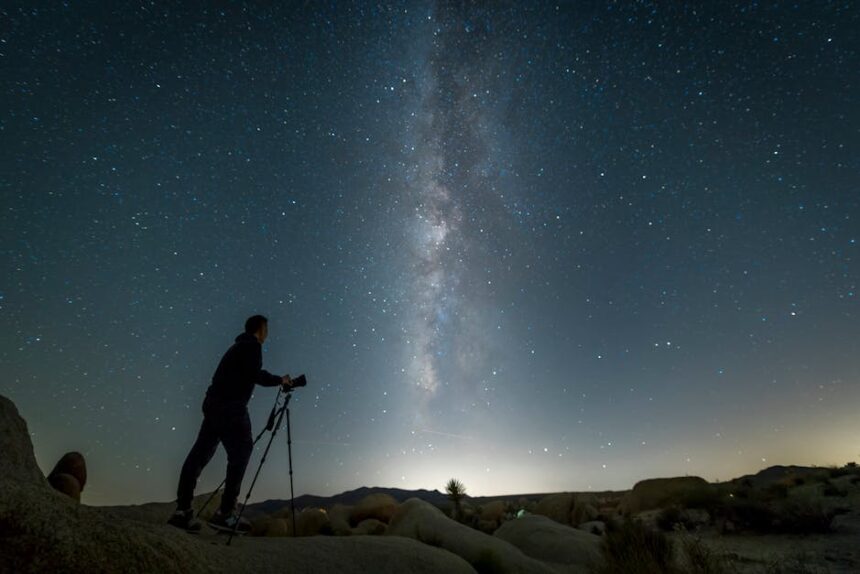
Most astrophotographers begin with a mirrorless or DSLR camera mounted on a sturdy tripod, and many stay there. A wide-angle lens set to its widest aperture, combined with exposures in the 25-to-30-second range, can produce sharp, detailed images of starry skies. The Milky Way is typically visible and photographable between April and September.
Composition carries significant weight at this stage. Pairing the sky with a landscape, a foreground element, or a city skyline separates strong images from forgettable ones. Shooting in RAW is standard practice, making post-processing more flexible. The same skill set, once built, transfers to aurora and meteor shower photography.

The next step up involves a star tracker — a motorized mount that compensates for Earth’s rotation. By moving the camera in sync with the sky, a tracker extends possible exposure times well beyond the 25-to-30-second hard limit, allowing more light to accumulate and finer detail to emerge. The report identifies star trackers as the logical bridge between casual nightscapes and more technical deep-sky work.
Beyond trackers, the discipline branches further: telescopes, dedicated astronomy cameras, and highly specialized rigs for imaging faint deep-sky objects. Each step adds complexity and cost, but also opens targets unavailable to simpler setups.
What the range of approaches shares is a common entry point — one camera, one lens, one tripod, and a willingness to stay outside after dark long enough to get the settings right. The 25-second rule applies to everyone on their first night out.
Photo by Ken Cheung on Pexels
This article is a curated summary based on third-party sources. Source: Read the original article