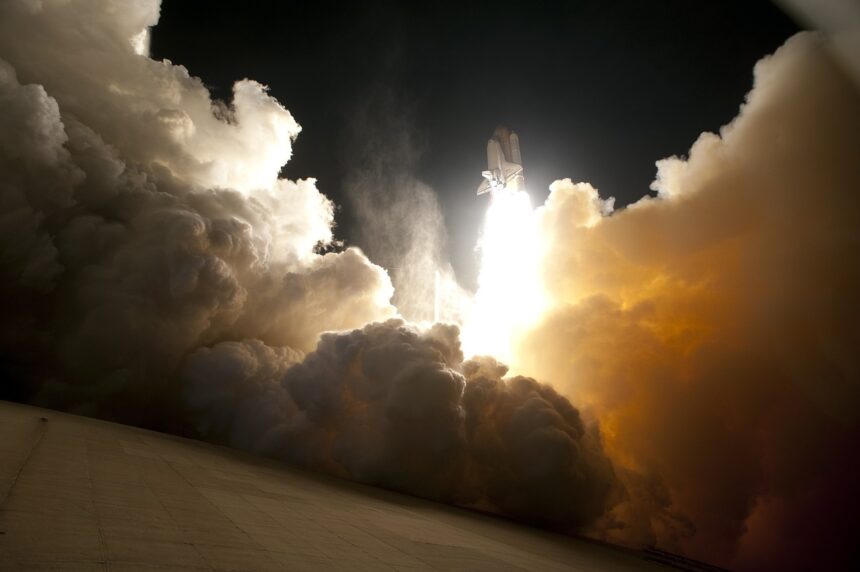
Model rocketry sits at the intersection of hands-on building and applied physics — a hobby that has historically carried an intimidating reputation it largely does not deserve. Today’s beginner kits have stripped away that barrier, offering everything from pre-assembled launchers to simple glue-and-go assembly sets that work for ages 10 and up.
The entry point that requires the least preparation is the Estes Industries NASA SLS kit. It arrives pre-assembled and pre-painted, meaning launch preparation is limited to attaching the included transparent fins and loading a compatible engine — Estes recommends the C5-3 or C6-3, both sold separately. The rocket reaches a projected maximum altitude of 350 feet (107 meters), deploys a 15-inch (38.1 cm) parachute for recovery, and doubles as a display model when not in flight. At 19.4 inches (49.3 cm) long and 1.19 kg, it is a faithful scale representation of NASA’s Space Launch System heavy-lift vehicle. A launch pad and controller are required but are compatible with most other rockets in the Estes lineup, making them a one-time investment.
A Step Up in Assembly
For those who want the building process to be part of the experience, the Estes Rockets Alpha III moves from ready-to-fly into easy-assembly territory. The kit includes a pre-colored body tube, nose cone, and fins in black and orange, requiring only glue and basic household tools such as scissors. According to the report, the set is compatible with A, B, and C-class engines and carries a projected maximum altitude of 1,150 feet (351 meters) — more than three times the ceiling of the SLS kit. Recovery is handled by a 12-inch (30.5 cm) parachute. At 12.1 inches (30.7 cm) long and 0.34 kg, it is notably lighter and smaller than the SLS model, and its engine compatibility range — spanning 1/2A6-2 through C6-7 — gives flyers more room to experiment as their experience grows. Engines are again sold separately, and the kit is rated for ages 10 and up.
Other Kits in the Lineup
The broader beginner range covered in the source includes several additional options worth noting:
- Estes Rockets Journey Launch Set — a bundled set designed to get beginners airborne with minimal additional purchases
- Estes Rockets Rascal & Hijinks Launch Set — a dual-rocket package suited to those who want variety from their first purchase
- Stomp Rocket Ultra Rockets — a non-engine alternative that uses air pressure, lowering the age and safety threshold considerably
- National Geographic Power Rocket — positioned as an educational option with a focus on science learning alongside the flying experience
Across the full range, the consistent variables separating one kit from another are assembly complexity, maximum altitude, engine class compatibility, and whether a launch system is included. Beginners prioritizing immediate flight will gravitate toward the pre-assembled NASA SLS; those who want the build to be as engaging as the launch will find the Alpha III a more deliberate starting point. Either way, the required investment in a reusable launch pad and controller applies across virtually all Estes products, making the first purchase the most consequential one in terms of upfront cost.
Photo by Pixabay

This article is a curated summary based on third-party sources. Source: Read the original article