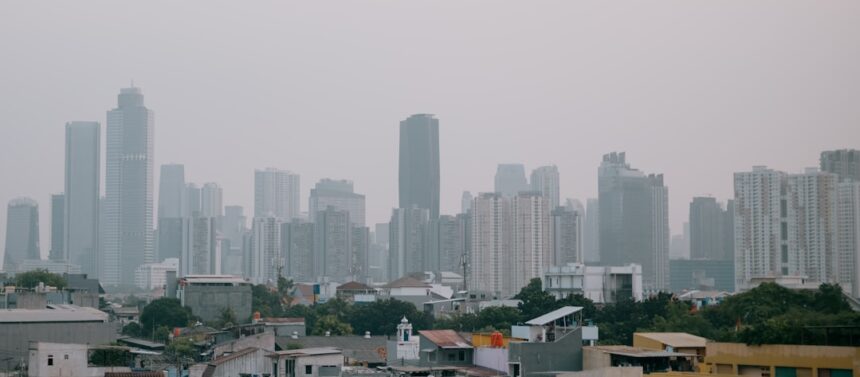
Thick black raindrops fell on rooftops and streets across Tehran on 8 March, coating cars and filling balconies with soot. Residents reported burning eyes and aching throats. The city, which had only recently emerged from a prolonged drought, was suddenly receiving precipitation unlike anything its infrastructure was built to handle.
The cause was a series of overnight US-Israeli strikes that hit Iranian oil facilities for the first time since the conflict began roughly a week earlier. Four oil storage facilities and an oil transfer centre in Tehran and the adjacent Alborz province were set ablaze. Flames loomed over the capital through the night. By day, black smoke had swallowed the skyline.
What the rain actually contains
The black rain is almost certainly a product of those fires. When precipitation falls through heavily polluted air, it strips soot and other particles from the smoke column and carries them to the ground. But the precise chemical contents remain unknown — scientists say they are missing basic data, starting with the smoke’s composition.
Anna Hansell at the University of Leicester describes it as “quite a nasty toxic moisture.” The oil burning in storage facilities would have been thicker and less refined than petrol, meaning combustion was far less complete. That produces a complex mix: partially and fully burnt carbon, polyaromatic hydrocarbons, and — because oil contains sulphur and nitrogen — sulphur and nitrogen oxides that can react with atmospheric moisture to produce acid rain.
Because missiles struck physical structures, the smoke also likely carries pulverised concrete, glass, and plastics. There is a further unresolved question: whether the blackness comes entirely from burning diesel smoke carried in raindrops, or whether actual oil droplets are also raining out. “I’m not clear if the blackness is solely caused by burning diesel, where you get this sort of greasy black smoke that’s being carried in the raindrops, or whether you’ve actually got some very small droplets of oil as well,” Hansell says.
The scale may be without modern precedent. Hansell draws a comparison to the smog that blanketed London through much of the 20th century, most severely in 1952. “This is potentially several orders of magnitude larger than the London smog,” she says.

How it affects human health
If the contaminated rain reaches drinking water supplies, people could experience gastrointestinal effects — stomachaches, heartburn, or diarrhoea — depending on concentration and chemical make-up. Acid rain forming from nitrogen and sulphur dioxide would explain the eye and throat irritation residents are already reporting.
According to the analysis, the more immediate danger may not be the rain itself but the airborne smoke. Fine particles can penetrate deep into the lungs and potentially enter the bloodstream. “If you get raindrops on your skin, yes, there will be some potentially carcinogenic compounds on your skin, but you can wash that off,” Hansell says. “If they get into your nose and mouth, they might persist for longer, but very fine smoke particles in the air can penetrate deep into the lungs and potentially get into the bloodstream.”
High concentrations of airborne particles raise all-cause mortality. The chemical composition, while serious, is described as a secondary concern compared to that baseline physical threat.
This article is a curated summary based on third-party sources. Source: Read the original article