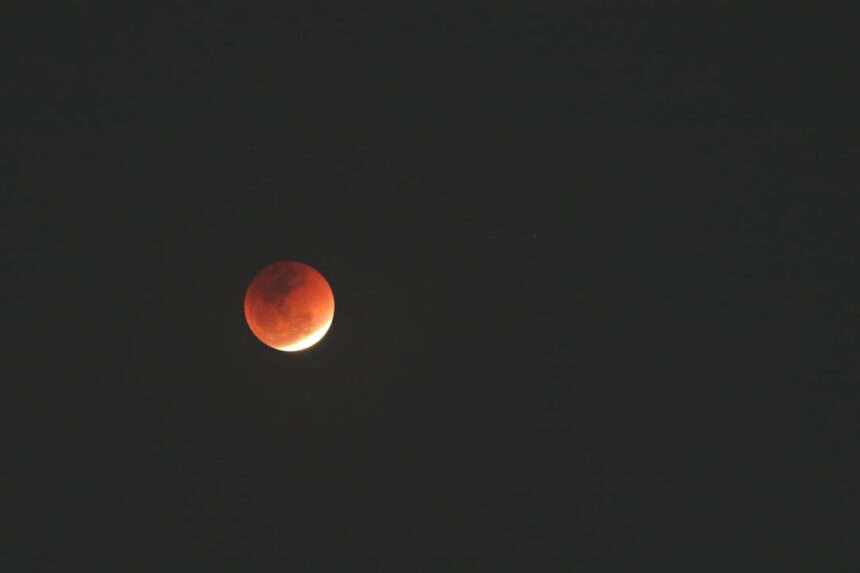
The night sky on March 3rd will host a total lunar eclipse — what many call a blood moon, when Earth positions itself directly between the Sun and the Moon, casting its shadow across the lunar surface and turning it a deep, rusty crimson.
The color is pure physics. When Earth fully blocks direct sunlight from reaching the Moon, its atmosphere acts as a lens, scattering shorter blue wavelengths away while bending longer red and orange ones onto the Moon’s disk. The effect is essentially every sunrise and sunset on Earth projected simultaneously onto its natural satellite. How deep the red goes depends on what’s in the atmosphere at the time — volcanic ash and dust produce darker, more dramatic hues, while cleaner air yields something closer to amber.
Total lunar eclipses occur roughly once every one to two years. They are entirely predictable — astronomers can calculate them centuries in advance — and unlike solar eclipses, they require no protective equipment to observe. You can simply look up.
The mythology around them, however, has never been so calm about it.
Ancient civilizations across Mesopotamia, China, Mesoamerica, and Europe read lunar eclipses as cosmic warnings. In ancient China, a celestial dragon or dog was thought to be attempting to swallow the Moon whole, prompting people to bang drums and shoot arrows into the sky to drive it away. Ancient Sumerians believed demons were attacking the Moon, and feared the event foretold a king’s downfall. As a precaution, priests would install a substitute ruler and perform protective ceremonies. The Christian Old Testament, in the Book of Joel, references the Moon turning to blood as a sign of impending divine reckoning.
Across cultures, the pattern is consistent: a red Moon meant something was wrong. Something powerful and beyond human control was stirring.

That same instinct runs through *The Legend of Zelda* franchise, particularly in *Breath of the Wild* and *Tears of the Kingdom*. In both games, the blood moon is a recurring in-game event in which the sky turns red, an eerie musical cue plays, and previously defeated enemies are resurrected. It functions as a mechanical reset — a reminder that the world’s corruption is ongoing and cannot be permanently cleared away. For players, it’s equal parts ominous and practical. Enemies you’ve cleared are back. Resources replenish. The threat persists.
The visual language Zelda borrows from real blood moons is deliberate and effective. That deep red sky communicates dread immediately, drawing on centuries of cultural conditioning. The emotional response it produces in players is the same one an ancient Sumerian might have felt looking up at the sky.
Where the two diverge is consequence. A real blood moon carries no threat. It changes nothing on the ground. The Moon turns red, then fades back to white, and the world continues as it was. It is striking but inert — a light show with no script attached.
In Zelda, the blood moon is a plot device, a reminder of Calamity Ganon’s lingering malevolence pulsing through the land. It is structurally tied to doom. The real version is simply the geometry of three celestial bodies briefly aligning, rendered spectacular by atmospheric optics.
Both, though, do something similar to the person watching. They make the Moon feel significant. Like it is trying to say something.
Photo by Aditya Vyas on Unsplash
This article is a curated summary based on third-party sources. Source: Read the original article