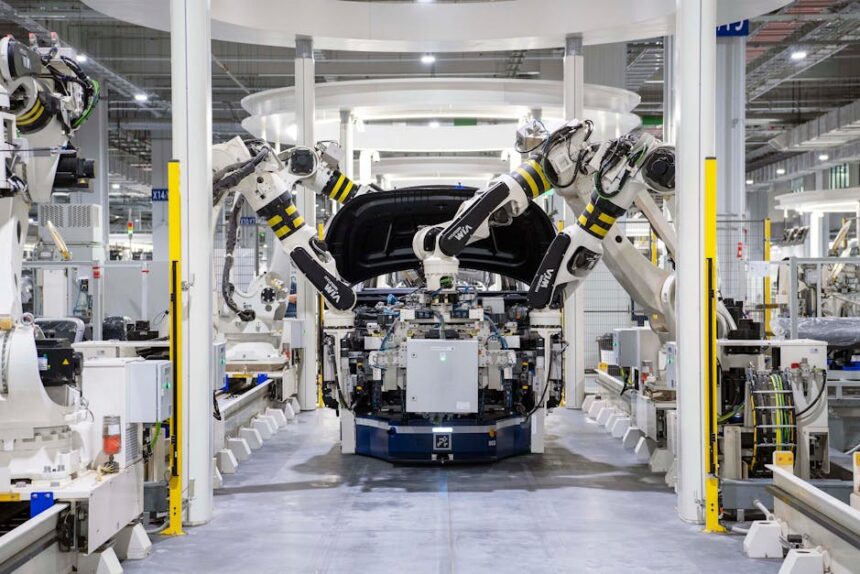
Physical AI adoption in manufacturing has been moving fast in North America and Asia — BMW Group has now brought that shift to European soil.
The company has deployed a humanoid robot at its Leipzig plant in Germany for the first time, running a pilot with AEON, a wheeled humanoid developed by Hexagon Robotics‘ Zurich-based division. According to the announcement, this is the first automotive deployment of AEON anywhere in the world. The pilot’s summer 2026 phase will see two AEON units operate simultaneously across two use cases: high-voltage battery assembly and component manufacturing for exterior parts.
Leipzig was a deliberate choice. The plant combines battery production, injection moulding, press shop, body shop, and final assembly under one roof — making a successful deployment there effectively a validation of physical AI across the full production spectrum, rather than a narrow single-task trial.
What AEON Is Built to Do
The machine reflects a specific design philosophy. Arnaud Robert, President of Hexagon Robotics, stated at a Munich event: “We’re not in the dancing business — we’re in the working business.” AEON moves on wheels rather than legs, a decision reached after extensive locomotion testing, with Hexagon concluding that on flat factory floors, wheels deliver meaningfully better speed and energy efficiency. The robot stands 1.65 metres tall, weighs 60 kilograms, reaches speeds of 2.5 metres per second, and can autonomously swap its own battery in 23 seconds, enabling continuous operation without human intervention.
Its 22 integrated sensors — covering peripheral cameras, time-of-flight, infrared, SLAM cameras, and microphones — provide full 360-degree real-time spatial awareness and support quality inspection tasks that stationary robots cannot perform. A human-like torso design allows flexible docking of grippers, hand elements, and scanning tools across different production environments. Onboard processing runs on NVIDIA Jetson Orin computers, with core locomotion capabilities developed through simulation via NVIDIA‘s Isaac platform. Microsoft Azure supports scalable model development, and Maxon supplies the actuators.
Built on Years of Groundwork
The Leipzig deployment is not BMW‘s first contact with humanoid robots in production. In 2025, the company ran a ten-month pilot at its Spartanburg, South Carolina plant using Figure AI‘s Figure 02 robot — supporting production of over 30,000 BMW X3s, with the robot working 10-hour shifts and moving more than 90,000 components in total. Leipzig inherits the operational lessons from that trial.

AEON’s first test at Leipzig took place in December 2025, with a further test run scheduled for April 2026 before the full pilot phase begins in summer 2026. To manage this work at scale, BMW has established a Centre of Competence for Physical AI in Production. Felix Haeckel, Team Lead for the centre, described the intent as “pooling our expertise to make knowledge on AI and robotics widely usable within the company.” Underpinning the entire operation is a unified data platform that replaced fragmented data silos across BMW‘s production network — the infrastructure layer that allows AI agents to operate and learn continuously.
The broader industry trajectory supports the timing. A Deloitte State of AI in the Enterprise 2026 report, surveying more than 3,200 senior leaders across 24 countries, found that 58% of companies are already using physical AI in some capacity, with that figure projected to reach 80% within two years. The Leipzig pilot lands squarely within that curve.
Photo by Hyundai Motor Group on Pexels
This article is a curated summary based on third-party sources. Source: Read the original article