Astronomers have been building toward a more complete picture of early galaxy evolution, and the detection of hydroxyl megamasers — natural microwave beams produced during galaxy collisions — has become one of the more direct tools for studying that process. A newly identified signal now pushes the boundaries of what that tool can reveal.
Using the MeerKAT telescope, an array of 64 radio dishes in South Africa, researchers have detected the brightest and most distant hydroxyl megamaser ever recorded. The source is a pair of merging galaxies designated HATLAS J142935.3–002836, located approximately 8 billion light-years from Earth. According to the report, the microwaves reaching us were emitted when the universe was roughly half its current age.
The signal is strong enough that the team has proposed a new classification for it entirely.
From Megamaser to Gigamaser
A hydroxyl megamaser forms when two galaxies violently collide. The collision compresses enormous clouds of gas, exciting hydroxyl (OH) molecules that then release high-energy microwaves — a natural process that mirrors the mechanics of human-made lasers, where particles are excited and the resulting waves are amplified. The key difference is the wavelength: masers emit microwaves rather than visible light.
The microwaves streaming from HATLAS J142935.3–002836 measure around 18 centimeters in length, at approximately 1,665 megahertz. Their brightness so far exceeds that of other known megamasers that the researchers have proposed classifying the signal as a “gigamaser” — the next theoretical order of magnitude for this class of object. The study was uploaded on February 13 to the preprint server arXiv and accepted for future publication in Monthly Notices of the Royal Astronomical Society: Letters.
“This system is truly extraordinary,” said Thato Manamela, an astronomer at the University of Pretoria and the study’s first author. “We are seeing the radio equivalent of a laser halfway across the universe.”

Why It’s Visible at All
Signals from 8 billion light-years away are typically too faint for instruments like MeerKAT to resolve. This one reached detectable levels only because of gravitational lensing — a phenomenon first predicted by Albert Einstein‘s theory of relativity, in which the gravity of an intervening mass bends and magnifies light passing around it. That magnification brought the otherwise unreachable signal within range.
HATLAS J142935.3–002836 was first identified in 2014. Researchers consider megamasers valuable as “cosmic beacons” because they offer direct insight into how ancient galaxies formed, grew, and changed over time — processes that remain difficult to observe at such distances through other means.
The study has been accepted for future publication in Monthly Notices of the Royal Astronomical Society: Letters.
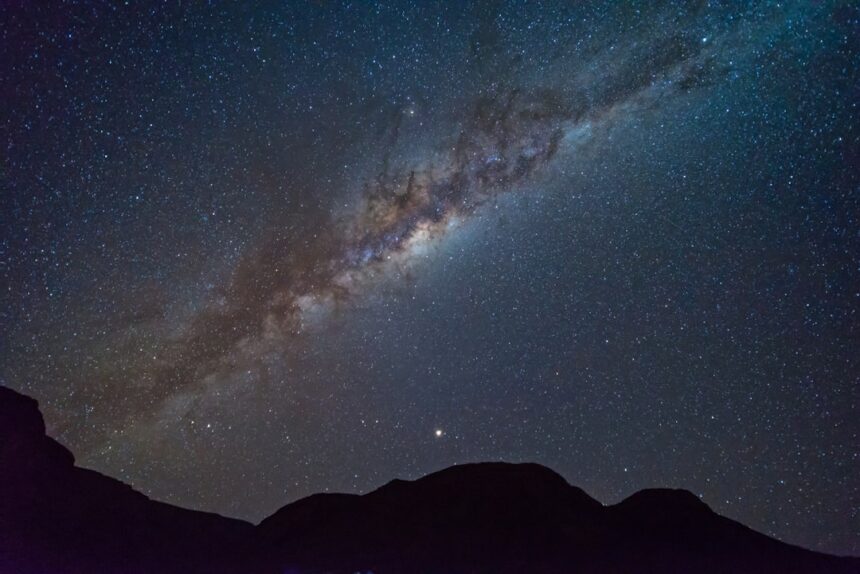
Photo by Kyle Goetsch on Unsplash
This article is a curated summary based on third-party sources. Source: Read the original article