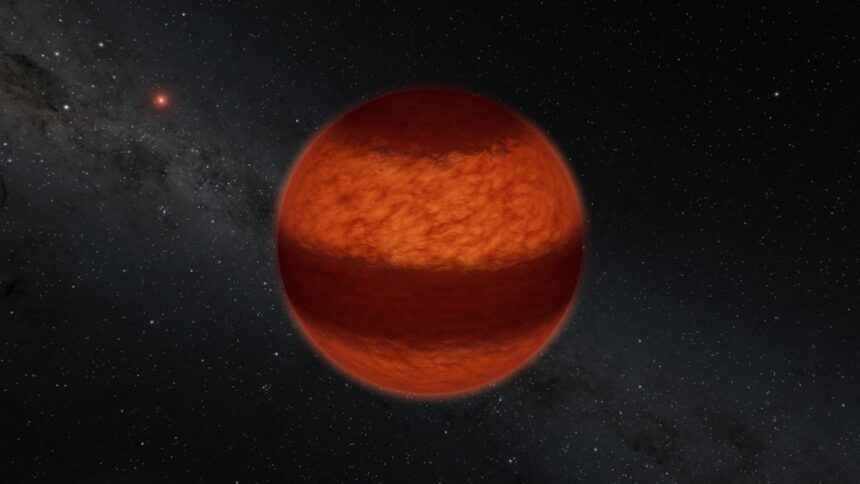
Brown dwarfs, the celestial objects that occupy the murky space between planets and stars, may not belong to a distinct category at all. A new study suggests the boundary separating “failed stars” from “overgrown planets” is less a clear line and more a blurred continuum stretching across a wide range of masses.
Researchers at the University of California Los Angeles, led by astrophysicist Gregory Gilbert, examined a sample of 70 objects ranging from Jupiter-mass planets to brown dwarfs sitting right at the edge of stellar classification. Their findings appear in The Astronomical Journal.
Two Very Different Recipes
Stars and planets form through entirely different processes. Stars build from the outside in: a clump of gas in a molecular cloud collapses under its own gravity, and the compressed atoms at its core begin fusing, releasing energy. To qualify as a true star, an object needs at least 80 times the mass of Jupiter.
Planets form from the inside out. Dust grains in the disk surrounding a newborn star clump together, their combined gravity pulls in more material, and a rocky core gradually accumulates thick layers of gas around it. This process is called core accretion.
Brown dwarfs sit uncomfortably between these two worlds. Ranging from 13 to 80 times Jupiter’s mass, they lack the heft to fuse ordinary hydrogen into helium like a real star. They can, though, fuse deuterium, an isotope of hydrogen that requires less pressure to ignite than standard hydrogen.
Where the Lines Blur
The research team hoped to find a clean mass threshold separating objects that formed by gravitational collapse from those that built up through core accretion. They looked at properties like host star metallicity (whether the parent star contained elements heavier than helium) and the shape of the objects’ orbits. No clean boundary emerged.

The messiness runs in both directions. In 2024, study co-author Steven Giacalone identified a brown dwarf that appeared to have formed through core accretion, placing it functionally in the category of the largest planet ever found. Meanwhile, some sub-brown dwarfs, gas giants too small to meet even the brown dwarf threshold, appear to have formed through gravitational collapse.
As the researchers note, “exactly how large of an object can be formed by core accretion or how small of an object can be formed by disk instability or cloud fragmentation remains to be determined.”
A Category That Keeps Resisting Definition
The study reinforces a growing suspicion among astronomers that the classical boundaries dividing planets, brown dwarfs, and stars describe tendencies rather than hard rules. Formation pathways once assumed to produce objects only within a specific size range are proving more flexible than expected.
- Objects with fewer than 13 Jupiter masses: typically classified as planets
- 13 to 80 Jupiter masses: brown dwarfs, capable of deuterium fusion
- Above 80 Jupiter masses: true stars, capable of hydrogen fusion
- Sub-brown dwarfs: gas giants too large for standard planetary classification but too small for brown dwarf status
What the 70-object sample ultimately reveals is that nature does not sort neatly into the bins astronomers have built for it. The universe, as Gilbert and his colleagues found, is under no obligation to cooperate.
Photo by NASA Hubble Space Telescope on Unsplash
This article is a curated summary based on third-party sources. Source: Read the original article