Two serious setbacks in 2025 had left Firefly Aerospace‘s orbital launch program under scrutiny — a failed satellite delivery in April and a first-stage explosion on the test stand in September. Against that backdrop, the company’s “Stairway to Seven” mission carried considerable weight.
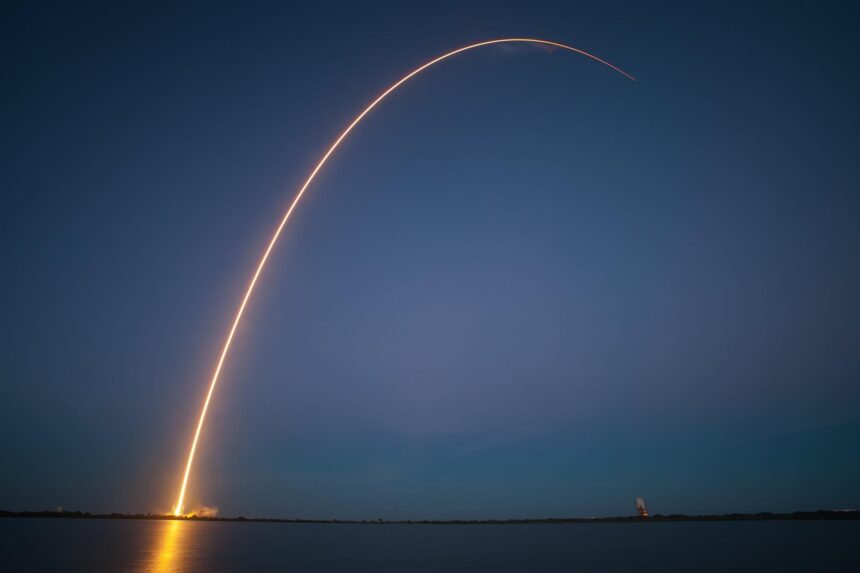
On March 11, 2026, Firefly Aerospace launched its Alpha rocket from Space Launch Complex-2 at Vandenberg Space Force Base in California. Liftoff came at 8:50 p.m. ET. The rocket performed as intended throughout its ascent, executing first-stage separation at approximately 2 minutes, 40 seconds into flight. Fairing ejection followed roughly 30 seconds later. The upper-stage engine cut off about 8 minutes after liftoff, placing Alpha in orbit at 151 miles (243 kilometers) above Earth.
“Mission success! Alpha Flight 7 achieved nominal performance and validated key systems ahead of our Block II configuration upgrade. This test flight also delivered a demonstrator payload for @LockheedMartin,” the company wrote on X following the flight.
What Went Wrong Before
The road to Flight 7 was unusually rough. The prior mission, “Message in a Booster,” failed in April 2025 when an anomaly during stage separation prevented a Lockheed Martin technology-demonstrating satellite from reaching orbit. Then, in September 2025, the first stage intended for “Stairway to Seven” exploded on the stand during prelaunch testing, pushing the mission timeline back by months.
The explosion was traced to “a process error during stage one integration that resulted in a minute hydrocarbon contamination,” according to a Firefly update from November. The finding ruled out any design flaw and cleared the vehicle to return to the pad. The company reframed the mission as a test flight, targeting “nominal first and second stage performance” rather than a standard commercial deployment profile.
With Flight 7 now complete, Alpha has achieved full mission success three times across its seven orbital launch attempts.

What Comes Next
Firefly will retire the Block I configuration of Alpha following this flight. The next version, Block II, is slated to debut on Flight 8. According to the announcement, Block II will stand approximately 7 feet (2.13 meters) taller than the current 96.7-foot-tall (29.6-meter) vehicle and will feature upgraded avionics, improved power systems, and enhanced thermal protections.
The result sits within a broader picture of uneven progress for the Texas-based firm. Earlier in 2025, its uncrewed Blue Ghost moon lander became the first private spacecraft to successfully complete a mission on the lunar surface — a high-profile achievement in a different part of the business. Alpha’s orbital record has been more inconsistent, though Flight 7 also delivered a demonstrator payload for Lockheed Martin, despite being classified as a test flight.
Firefly Aerospace says the Block II configuration upgrade will debut on Alpha’s eighth flight.
Photo by Pixabay
This article is a curated summary based on third-party sources. Source: Read the original article