Fifty years is a long time to sit with a puzzle. Astronomers have spent roughly that long trying to explain why most large galaxies near the Milky Way are drifting outward instead of being pulled in by the combined gravity of the Local Group. A team led by Ewoud Wempe of the Kapteyn Institute in Groningen now says it has the answer.
The solution is structural. According to the research, the matter surrounding the Local Group is arranged in a broad, flattened sheet stretching tens of millions of light-years across. Above and below that sheet sit enormous empty regions — cosmic voids — almost entirely devoid of galaxies. That geometry, the team argues, is what resolves the contradiction.
A Virtual Twin of Our Cosmic Neighborhood
To reach this conclusion, the researchers built a computer simulation starting from conditions in the early universe. They used measurements of the cosmic microwave background to estimate how matter was distributed shortly after the Big Bang, then ran those initial conditions forward in time. The result was a model that replicates the masses, locations, and motions of both the Milky Way and Andromeda, along with the positions and velocities of 31 galaxies just outside the Local Group. The team calls it a “virtual twin” of our cosmic environment.
When the flat sheet of matter is included in the model, the surrounding galaxies move outward at speeds closely matching what astronomers actually observe. The mechanism is a counterbalance: galaxies inside the plane feel gravitational pull not just from the Local Group at the center, but from additional mass spread across that same plane. That distributed mass offsets the inward pull. Galaxies outside the plane, sitting in the nearly empty voids, have no such counterweight — but there are almost no galaxies there to observe in the first place.
The sheet itself is dominated by dark matter, the invisible material that surrounds galaxies and accounts for most of the matter in the universe. Its presence in the flat structure is what gives the sheet enough mass to neutralize Local Group gravity at those distances.
Why Andromeda Is the Exception
The findings also clarify a companion fact that has been understood for decades without being fully integrated into this picture. Andromeda is moving toward the Milky Way at roughly 100 kilometers per second — the one nearby large galaxy that breaks the outward-drift pattern. Its trajectory makes sense under the new model: it sits close enough to the Local Group‘s center of mass that the sheet’s counterbalancing effect does not apply.

The study, the announcement says, is the first detailed attempt to map the distribution and motion of dark matter specifically in the region surrounding the Milky Way and Andromeda. Wempe described the goal as exploring “all possible local configurations of the early universe that ultimately could lead to the Local Group,” adding that having a model consistent with both the broader cosmological framework and local dynamics is a meaningful outcome. The work originates from the University of Groningen.
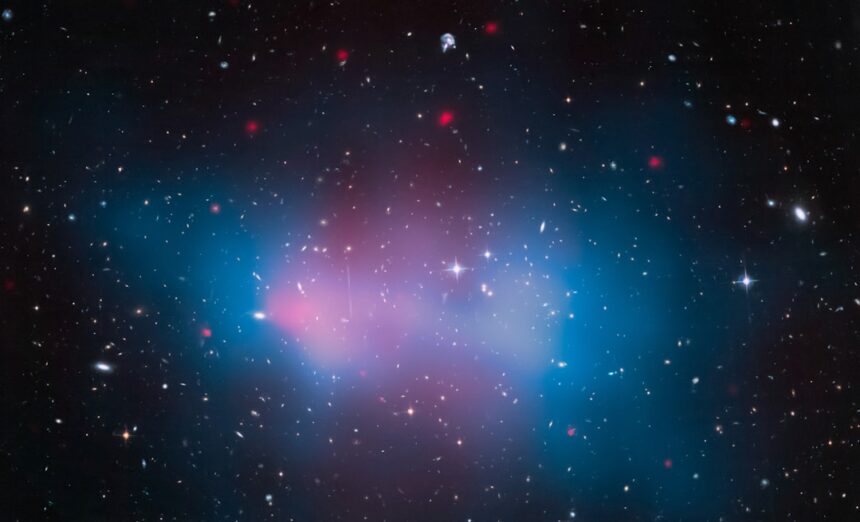
Photo by NASA Hubble Space Telescope on Unsplash
This article is a curated summary based on third-party sources. Source: Read the original article