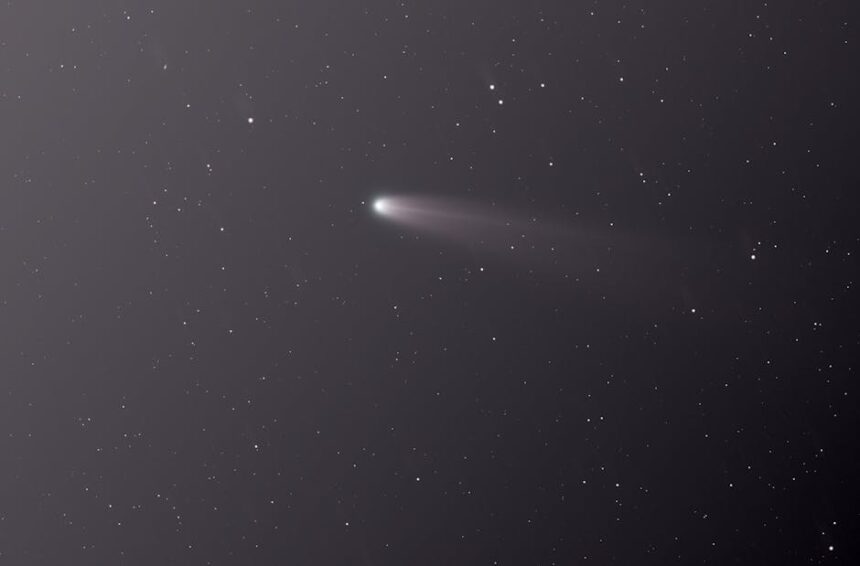
Interstellar comet 3I/ATLAS contains methanol at concentrations that set it apart from every comet observed in our own solar system, according to a new study using the Atacama Large Millimeter/submillimeter Array in Chile.
Researchers detected strong methanol signals in the comet’s expanding gas cloud as sunlight warmed its icy surface during its approach to the sun, causing the release of gas and dust that formed a glowing coma around the nucleus — giving ALMA‘s radio antennas a clear chemical window into the object’s composition.
The methanol-to-hydrogen-cyanide ratio is far higher than what astronomers typically find in solar system comets. That imbalance, according to the announcement from the National Radio Astronomy Observatory, points to an origin in a planetary system with colder temperatures or a fundamentally different chemical makeup than the one that produced Earth’s neighboring comets.
A Fingerprint From Another System
“Observing 3I/ATLAS is like taking a fingerprint from another solar system,” said Nathan Roth, lead author and professor at American University. “The details reveal what it’s made of, and it’s bursting with methanol in a way we just don’t usually see in comets in our own solar system.”
Methanol itself is not exotic — it forms on icy dust grains in interstellar clouds and gets incorporated into comets during planet formation. The unusual element here is the quantity relative to other molecules detected, making the comet a rare chemical sample from outside the solar system.
The ALMA data also revealed a behavioral distinction: hydrogen cyanide streams primarily from the comet’s nucleus, while methanol is released both from the nucleus and from icy grains suspended in the coma — essentially acting as miniature secondary sources. The announcement describes this as the first time such detailed outgassing behavior has been mapped in any interstellar object.

Third Known Interstellar Visitor
3I/ATLAS was discovered in July 2025 by the Asteroid Terrestrial-impact Last Alert System, making it only the third confirmed object to enter the solar system from interstellar space. The first, ‘Oumuamua, arrived in 2017. The second, 2I/Borisov, followed in 2019 and displayed a more conventional comet-like appearance.
Since its discovery, the Hubble Space Telescope and the James Webb Space Telescope, along with observatories worldwide, have tracked the comet through the inner solar system. Images show a diffuse coma and faint dust tail. The outgassing also produces a separate phenomenon: a broad cloud of gas glowing in X-rays as solar wind particles collide with material escaping from the nucleus.
The chemical differences between 3I/ATLAS and solar system comets offer researchers a rare data point on how icy bodies — and by extension, planetary systems — form around other stars.
Photo by Enrico Bellodi on Pexels
This article is a curated summary based on third-party sources. Source: Read the original article