A few nanometers per second cubed. That is the size of the signal. Smaller than almost anything a seismometer routinely chases, yet apparently large enough to mean a volcano is about to blow.
Researchers from the Institut de Physique du Globe de Paris and the GFZ Helmholtz Centre for Geosciences in Potsdam have built a detection method around exactly that signal. They call it “Jerk.” According to the study, published in Nature Communications, the system uses a single broadband seismometer to catch the faint horizontal ground movements that rising magma produces as it fractures rock on its way toward the surface.
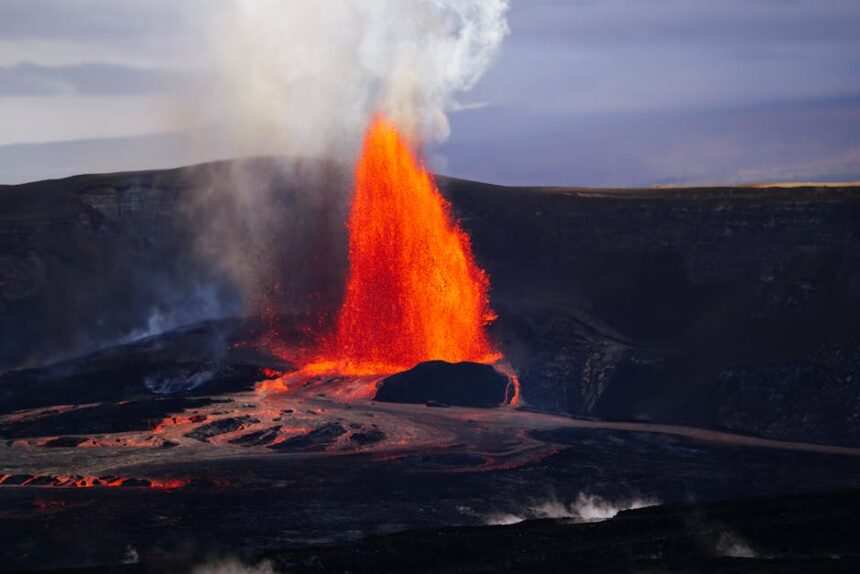
The team tested it over ten years at the volcanological observatory on La Réunion, home to Piton de la Fournaise, one of the world’s most persistently active volcanoes. Between 2014 and 2023, the island produced 24 eruptions. Jerk correctly forecast 92% of them.
What the signal actually detects
Most forecasting methods work probabilistically — they mine large monitoring datasets for statistical patterns. Jerk takes a different approach. Dr. François Beauducel and Dr. Philippe Jousset, who led the research, designed it to detect a physical event directly: the impulse-like ground motions, recorded in both acceleration and tilt, that appear when magma intrudes into the crust. The signals measure only a few nanometers per second cubed (nm/s³), extraordinarily faint by any standard.
The system’s data processing corrects for confounding factors including Earth tides, which would otherwise obscure the target signature. Once the characteristic signal crosses a threshold, an alert fires.
Warning times in the La Réunion trial ranged from a few minutes to as long as eight hours before eruption onset — a window that, at the upper end, is operationally meaningful for evacuation decisions. About 14% of alerts did not lead to eruptions. The researchers note, however, that those alerts still captured genuine magma movement beneath the surface, making them physically real events rather than instrument noise.

Why the equipment requirement matters
False alarms sit at the center of volcano monitoring’s credibility problem. Incorrect warnings trigger costly evacuations, damage local economies, and erode public trust in monitoring agencies over time. A system producing alerts tied to confirmed magma movement, even when no eruption follows, offers a different kind of accountability than purely statistical triggers.
The practical case for Jerk rests partly on its simplicity. Because it requires a single broadband seismometer rather than a dense network of sensors and instruments, it is deployable at volcanoes that currently receive little or no close monitoring. Thousands of volcanoes worldwide fall into that category. The researchers say the low equipment threshold could make the method especially useful precisely in those under-watched locations, where the absence of data has historically meant the absence of warning.
Scientists first identified the underlying signals more than a decade ago while working through archival datasets from earlier Piton de la Fournaise eruptions. The decade-long prospective test that followed produced the 92% figure now attached to the method’s name.
This article is a curated summary based on third-party sources. Source: Read the original article