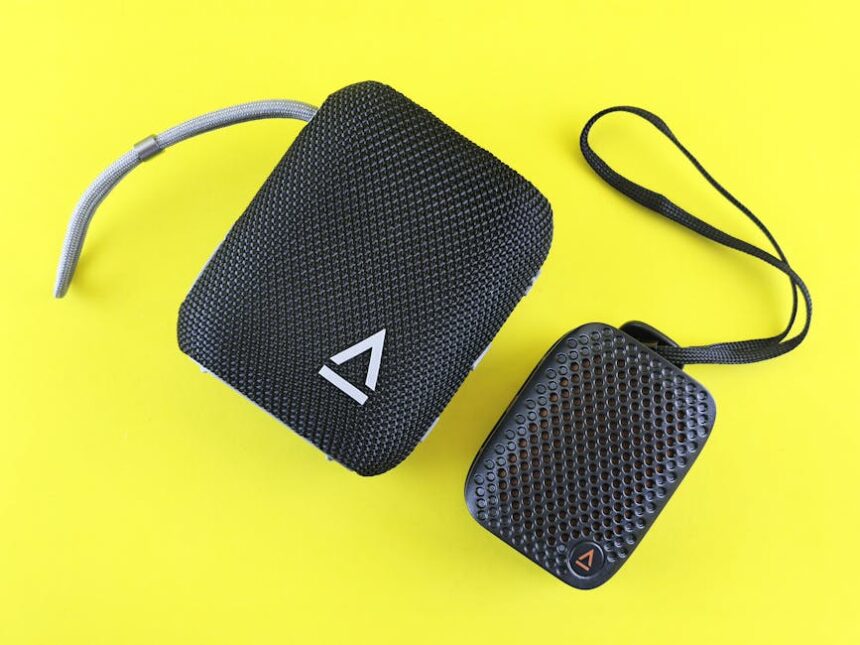
Ten years after the original, KEF has refreshed its Muo portable Bluetooth speaker with updated internals, a dust- and water-resistant body, and a $250 price tag that positions it firmly at the premium end of the market.
The original Muo launched in 2015 at a time when serious hi-fi brands rarely ventured into portable audio. That has changed considerably. JBL, Ultimate Ears, and a wave of budget competitors now offer genuinely good portable sound at a fraction of the cost. The new Muo enters a much harder fight.
Build and Design
The Muo’s body is a curved triangular prism machined from aluminum, with a seamless tube construction that reflects serious manufacturing effort. It measures 8.5 × 3.2 × 2.3 inches and weighs 1.6 lb, slightly heavier than most rivals but within a familiar form factor. Seven color options are available, including Moss Green, Orange Moon, Silver Dusk, Amber Haze, Blue Aura, Cocoa Brown, and Midnight Black.
The grille design draws from KEF’s flagship $225,000 Muon loudspeakers. A removable carrying strap is included; a protective case or travel bag is not, which feels like an omission at this price.
The original’s clicky buttons are gone, replaced by sealed, indented controls that contributed to the IP67 rating. That certification means full dust protection and short-term water submersion survival. The trade-off is that the new buttons require firm, deliberate presses. Aesthetically, the Muo is essentially unchanged from its 2015 predecessor.
Connectivity
Bluetooth 5.4 handles wireless audio with support for aptX Adaptive, AAC, and SBC. aptX Adaptive delivers near-CD quality streaming. Auracast support is included for broadcasting audio to multiple compatible speakers, though the broader Auracast ecosystem remains limited in practice.

The USB-C port carries digital audio as well as power. Connected to a computer or portable media player, the Muo operates as an external speaker at up to 24-bit/48 kHz resolution, depending on source compatibility. There is no 3.5 mm analog input. Google Fast Pair and Microsoft Swift Pair enable quick one-press Bluetooth pairing.
Two Muos can be paired in True Wireless Stereo mode to function as a dedicated left and right stereo pair, widening the soundstage. The pairing process requires coordinated button presses but proved stable during testing.
Audio Performance
The driver configuration centers on a new racetrack-shaped mid/bass driver measuring 2.5 × 5 inches, paired with a 0.74 inch tweeter. Total amplification is 40 watts of Class D, split as 30 watts for lows and 10 watts for highs. The result is tight, controlled bass and audio quality that holds up well against the premium positioning.
The KEF companion app offers only minimal control, which limits how much listeners can tune the sound to personal preference.
Battery
KEF rates the Muo at up to 24 hours of playback per charge. A 15-minute charge delivers three hours of use, and a full charge takes two hours. That puts it among the stronger performers in the portable speaker category on endurance alone.
At $100 more than KEF‘s own recommended rival, the JBL Flip 7, the Muo makes a case built on materials, connectivity depth, and acoustic performance rather than value. For listeners who want the USB-C audio path, aptX Adaptive, and the aluminum build in one package, the premium is easier to justify.
Photo by Andrey Matveev on Pexels
This article is a curated summary based on third-party sources. Source: Read the original article