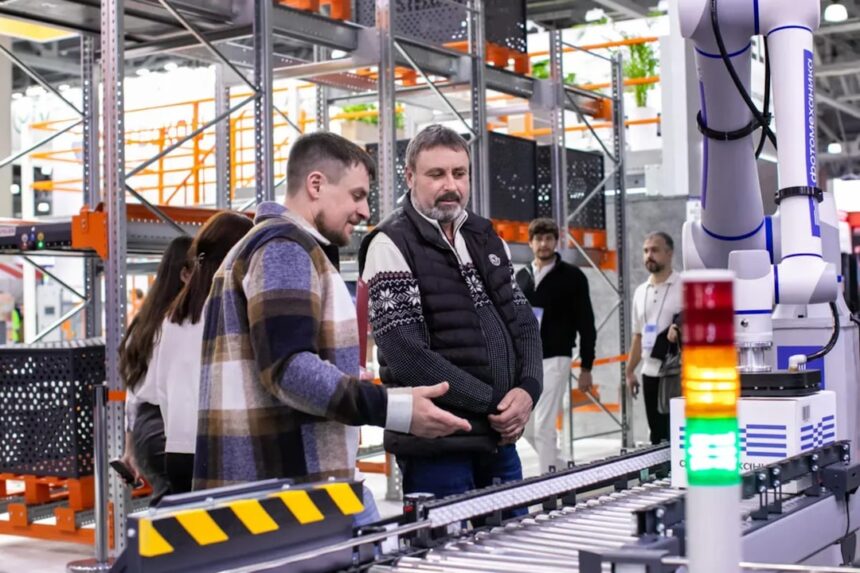
The factory floor has always been a test of what machines can reliably repeat. The next test is what they can reliably understand.
That distinction sits at the center of a push by Microsoft and NVIDIA to move manufacturers past automation into what the two companies call physical AI — intelligence that can sense, reason, and act in dynamic, real-world environments. Not software optimizing a spreadsheet. Systems operating alongside people on a factory floor, adapting in real time.
The argument is direct: traditional automation handles repetition well. It handles variability poorly. Human workers bring judgment and contextual awareness that machines lack, but they cannot scale. According to the announcement, physical AI closes that gap by enabling what the companies describe as “human-led, AI-operated systems” — people set the intent, intelligent systems execute, learn, and adjust.
Why the pilot phase is ending
Most manufacturers who adopted AI early did so in narrow configurations: task automation, utilization rates, cost reduction. Those deployments had value. They also created new problems — skills gaps, governance concerns, and uncertainty about how far to let systems act independently. The use cases multiplied without becoming strategic.
The shift Microsoft and NVIDIA are describing moves away from isolated tools toward what they call an “industrial frontier.” The framing centers on two requirements that frontier manufacturers treat as non-negotiable: intelligence, meaning AI that understands the actual data, workflows, and institutional knowledge of the business; and trust, meaning security, governance, and observability built into every layer of the system.
The companies say that without intelligence, AI remains generic. Without trust, adoption stalls. Both failures have played out in early deployments across the industry.

Infrastructure and the simulation layer
Physical AI at manufacturing scale, the announcement says, cannot be delivered through point solutions. It requires connected toolchains spanning simulation, data pipelines, AI models, robotics frameworks, and governance — all operating as a coherent system rather than a collection of experiments.
NVIDIA is building the underlying infrastructure: accelerated computing, open models, simulation libraries, and robotics blueprints designed to let the broader ecosystem build autonomous systems capable of perception, reasoning, planning, and action. Microsoft contributes the cloud and enterprise data platform, designed to run physical AI securely across heterogeneous environments.
One specific capability emerging from this architecture: simulation-grounded AI agents that let manufacturers evaluate production changes virtually before deploying them on the factory floor. The goal is risk reduction before any physical change is made — testing in simulation what would otherwise require stopping a line.
The stated ambition covers the full scope of manufacturing operations. The companies say the combined platform is intended to support AI deployment across product lifecycle decisions, factory operations, and supply chain coordination — not as discrete projects, but as a continuous, enterprise-wide system that can be developed, tested, and improved over time.
Specific use cases the announcement identifies include real-time production line optimization, maintenance and quality coordination, adaptation to supply or demand disruptions, and acceleration of engineering decisions. Each involves AI agents grounded in operational data and embedded in human workflows, with governance maintained end to end.
Photo by Trans Russia on Unsplash
This article is a curated summary based on third-party sources. Source: Read the original article